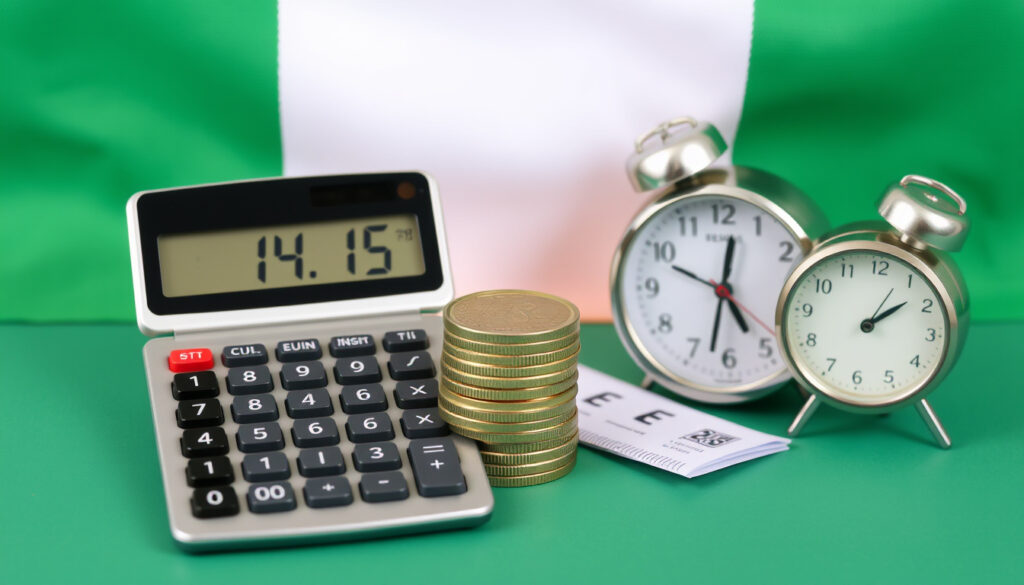
Minimum Wage in Ireland 2026: €14.15 Per Hour & Youth Rates
If you’re working in Ireland or planning to, few numbers matter more than the minimum wage — especially when it changes. From 1 January 2026, the national minimum wage in Ireland is €14.15 per hour for workers aged 20 and over, a €0.65 increase from the 2025 rate of €13.50.
National minimum wage from 1 January 2026: €14.15 per hour ·
Experienced adult employee rate: €14.15 per hour ·
Living wage (independent adult, no dependants): €15.40 per hour ·
Minimum wage for under 18s: approx. €9.91 per hour (70% of adult rate) ·
Minimum wage for 18-year-olds: approx. €11.32 per hour (80% of adult rate) ·
Minimum wage for 19-year-olds: approx. €12.74 per hour (90% of adult rate)
Quick snapshot
- €14.15 per hour for experienced adults (20+) from 1 Jan 2026 (Workplace Relations Commission — Ireland’s statutory wage authority)
- Youth sub-minimum rates: 70% for under 18, 80% for 18, 90% for 19 (Workplace Relations Commission)
- 2026 rate is an increase from €13.50 in 2025 (Leap29 — employment advisory)
- Future minimum wage after 2026 is not legislated; further increases are likely but unconfirmed (Living Wage Ireland — advocacy group)
- Living wage of €15.40 is a voluntary benchmark, not a legal requirement (Living Wage Ireland)
- Exact take-home pay after deductions depends on individual tax credits and circumstances (Living Wage Ireland — advocacy group)
- 1 January 2026: adult minimum wage rises to €14.15 per hour (Workplace Relations Commission)
- 2023–2025: minimum wage increased from €11.30 to €13.50 (Workplace Relations Commission)
- Ireland targets a living wage of €15.40, aligned with 60% of median hourly earnings (Living Wage Ireland)
- Government reviews minimum wage annually; further increases expected beyond 2026 (Workplace Relations Commission)
A 19-year-old working 40-hour weeks earns €1.41 less per hour than a colleague aged 20 or over — that’s over €2,900 a year less, despite doing the same job. The age-band system creates a real financial gap for younger workers.
The table below breaks down every age band rate that applies from 1 January 2026.
| Age group | Hourly rate | % of adult rate |
|---|---|---|
| 20 years and over (experienced adult) | €14.15 | 100% |
| 19 years | €12.74 | 90% |
| 18 years | €11.32 | 80% |
| Under 18 years | €9.91 | 70% |
Six rates, one pattern: the younger you are, the less you earn for the same hours — a tiered system that directly affects students, apprentices, and first-job workers.
The Workplace Relations Commission, Ireland’s statutory wage authority, publishes the official age-band rates and confirms these percentages apply from 1 January 2026. The Migrant Rights Centre Ireland also lists the 2026 rates as €14.15, €12.74, €11.32 and €9.91 for ages 20+, 19, 18 and under 18 respectively.
What is the new minimum wage in Ireland in 2026?
National minimum wage rate effective 1 January 2026
- The national minimum wage from 1 January 2026 is €14.15 per hour for workers aged 20 and over (Workplace Relations Commission — Ireland’s statutory wage authority).
- This is an increase of €0.65 from the 2025 rate of €13.50 (Leap29 — employment advisory).
- The 2026 rate applies to all employees aged 20 and over, unless they are in specific training or apprenticeship schemes with separate provisions.
Who qualifies as an experienced adult employee?
An experienced adult employee is someone aged 20 or over who has completed at least two years of continuous employment with the same employer, or who has a history of work experience in the field. The full adult rate of €14.15 applies to this group.
Workers under 20 are explicitly excluded from the full adult rate, no matter how long they’ve been on the job. This means a 19-year-old with three years of experience still earns 90% of the adult rate, not the full €14.15.
How does the 2026 rate compare to previous years?
- 2023: €11.30 per hour
- 2024: €12.70 per hour
- 2025: €13.50 per hour
- 2026: €14.15 per hour
The cumulative increase from 2023 to 2026 is €2.85 per hour — a 25% rise over four years, reflecting Ireland’s deliberate policy of phasing toward a living wage.
The pattern: Ireland’s minimum wage has risen faster than inflation in recent years, but the gap between the minimum rate and the living wage target of €15.40 remains at €1.25 per hour.
What are the sub-minimum rates for younger workers in Ireland?
Minimum wage for under 18s
- Workers under 18 are entitled to 70% of the adult minimum wage — approximately €9.91 per hour in 2026 (Workplace Relations Commission).
- This rate applies regardless of the number of hours worked or the type of job.
Minimum wage for 18 and 19 year olds
- 18-year-olds are entitled to 80% of the adult rate — approximately €11.32 per hour (Migrant Rights Centre Ireland — migrant worker advocacy).
- 19-year-olds are entitled to 90% of the adult rate — approximately €12.74 per hour (Migrant Rights Centre Ireland).
What is the minimum wage for a 14, 16, or 17 year old in Ireland?
- A 14 year old on minimum wage earns the under-18 rate of 70% of adult rate — approximately €9.91 per hour.
- A 16 year old on minimum wage also earns the under-18 rate of approximately €9.91 per hour (Workplace Relations Commission).
- A 17 year old earns the same under-18 rate of approximately €9.91 per hour.
Ireland does not have a separate minimum wage for 14, 16, or 17 year olds — all workers under 18 share the 70% rate. This means a 14-year-old working a summer job earns the same hourly rate as a 17-year-old working full-time.
The trade-off: younger workers get a lower rate, which may make employers more willing to hire them, but it also means a 17-year-old working 40 hours a week takes home €4.24 less per hour than a 20-year-old doing the same job.
What is 40 hours a week on minimum wage in Ireland?
Weekly pay at €14.15 per hour
- At €14.15 per hour, 40 hours per week yields €566 per week before deductions (Workplace Relations Commission).
- At the under-18 rate of €9.91 per hour, 40 hours per week yields approximately €396.40 per week.
Monthly pay at minimum wage
- For an adult (20+) working 40 hours per week: approximately €2,453 per month (gross).
- For a 19-year-old: approximately €2,208 per month.
- For a 16-year-old (under 18): approximately €1,717 per month.
Annual salary at minimum wage
- For an adult (20+) working 40 hours per week, 52 weeks: approximately €29,432 per year (gross).
- For a 19-year-old: approximately €26,499 per year.
- For a 16-year-old: approximately €20,613 per year.
All these figures are gross — before tax, Universal Social Charge (USC), and social insurance (PRSI) deductions. A single person earning the adult minimum wage of €29,432 would pay approximately €3,200 in income tax, €1,600 in USC, and €1,200 in PRSI, leaving roughly €23,400 net per year, or about €450 per week.
The table below shows what full-time earnings look like at the adult minimum wage across different time periods.
| Period | Gross amount |
|---|---|
| Weekly | €566 |
| Monthly (approx.) | €2,453 |
| Annual (52 weeks) | €29,432 |
The implication: at €29,432 a year, a single adult working full-time on minimum wage earns just above the poverty line for a single person in Ireland, but well below the median income of roughly €45,000.
Is 15 euro an hour a good salary in Ireland?
€15 per hour versus the national minimum wage
- €15 per hour is €0.85 above the minimum wage of €14.15 per hour.
- A 40-hour week at €15 per hour yields €600 per week, compared to €566 at the minimum wage — a difference of €34 per week or about €1,768 per year.
€15 per hour versus the living wage
- €15 per hour is below the living wage of €15.40 per hour (Living Wage Ireland — advocacy group).
- The living wage is calculated as 60% of median hourly earnings — it represents what a single person needs to have a basic but socially acceptable standard of living.
Comparison with average hourly earnings in Ireland
- Average hourly earnings in Ireland exceed €20 in many sectors (Trading Economics — economic data).
- For a single person working full-time, €15 per hour provides a modest but workable income — enough to cover basic costs but leaving little for savings or discretionary spending.
The paradox: €15 per hour sounds like a reasonable wage, but in Dublin, after rent and basic expenses, a single person on €15 per hour would have about €200–300 left per month — before any car, travel, or social costs.
Is 3000 euro a month a good salary in Ireland?
€3,000 monthly gross income compared to minimum wage
- €3,000 per month (gross) is above minimum wage earnings of about €2,453 per month for a full-time adult worker.
- At €3,000 per month, the equivalent hourly rate for a 40-hour week is roughly €17.30 per hour.
Cost of living for a single person in Ireland
- €3,000 per month gross translates to approximately €2,350 net after tax and deductions.
- Rent for a one-bedroom apartment in Dublin: €1,600–€2,000 per month.
- Utilities, groceries, and transport: €500–€700 per month.
- Remainder after basics: often €200 or less for savings, social life, and unexpected costs.
Housing and rent considerations
For a single person paying rent in Dublin, €3,000 is moderate at best. Outside Dublin, the same income goes further — rent for a one-bedroom in Cork or Galway might be €1,000–€1,400, leaving more room for savings.
The pattern: €3,000 per month is a reasonable income for a single person outside major cities, but in Dublin it leaves little after rent — which is why many young workers share housing or live with parents.
What is the hourly rate in Ireland and how is it calculated?
What counts as working time for minimum wage?
- The national minimum wage applies to all employees aged 20 and over (Workplace Relations Commission).
- Working time includes training required by the employer and travel time for work-related duties.
- The minimum wage does not apply to certain apprenticeship schemes or training programs with separate legislation.
Is lunch included in a 40-hour week?
- Lunch breaks are not paid unless stated in the employment contract (Workplace Relations Commission).
- A 40-hour work week typically means 40 hours of actual work, not including unpaid breaks — so a 9-hour day with a 1-hour unpaid lunch counts as 8 hours worked.
- If an employer provides a meal or meal allowance, the WRC allows up to €1.27 per hour worked to be counted toward minimum wage compliance (Workplace Relations Commission — statutory deductions).
Understanding the national minimum wage formula
The minimum wage is calculated as a simple hourly rate. For employees paid by salary, week, or month, the employer must ensure that total pay divided by total hours worked meets or exceeds the applicable hourly rate. Overtime pay is not mandated by minimum wage legislation, but the rate must apply to average hourly earnings over a pay period.
The catch: if your contract says “40 hours including an unpaid lunch,” your actual paid hours are 37.5, meaning you need to check that your total weekly pay divided by 37.5 still meets the minimum hourly rate.
Confirmed facts
- €14.15 per hour is the official national minimum wage from 1 January 2026 (Workplace Relations Commission — Ireland’s statutory wage authority).
- Sub-minimum rates apply based on age: 70% for under 18, 80% for 18, 90% for 19 (Migrant Rights Centre Ireland).
- The adult rate applies to employees aged 20 and over (Workplace Relations Commission).
- The living wage target is €15.40 per hour (Living Wage Ireland — advocacy group).
What’s unclear
- Future minimum wage after 2026 is not legislated; further increases are likely but unconfirmed.
- Living wage of €15.40 is a voluntary benchmark; it is not a legal requirement.
- Whether the 2027 minimum wage will close the gap to the living wage target depends on government decisions yet to be announced.
- Exact take-home pay after deductions varies based on individual tax credits and personal circumstances.
Since 1 January 2026, the national minimum wage is €14.15 per hour.
Citizens Information — official government advice
National Minimum Wage (20+) €13.50 (2025).
Workplace Relations Commission — previous rates table
The Irish Living Wage rate is €15.40 per hour.
Living Wage Ireland — campaign group
The pattern across all these numbers is clear: Ireland is methodically raising the floor every year, but younger workers face a significant gap. A 17-year-old earning €9.91 per hour takes home roughly two-thirds of what a 20-year-old earns for the same hours — a gap that only closes when they turn 20.
For a young worker in Ireland, the choice is straightforward: either wait until your 20th birthday to earn the full rate, or push for a job that pays above the minimum. For an employer, the tiered system provides a cost advantage for hiring younger staff — but it also risks demoralising workers who know they’re being paid less purely because of their age.
thehrcompany.ie, employsome.com, purpletree.ie, raisin.com, gpa.net, facebook.com, ie-kb.sage.com
Before the €14.15 rate took effect, workers had been earning €13.50 per hour following the 2025 minimum wage increase in Ireland.
Frequently asked questions
What is the minimum wage in Ireland for a 14 year old?
A 14 year old in Ireland is entitled to 70% of the adult minimum wage — approximately €9.91 per hour from 1 January 2026.
What is the minimum wage in Ireland for a 16 year old?
A 16 year old earns the under-18 rate of 70% of the adult wage — approximately €9.91 per hour from 1 January 2026.
What is the minimum wage in Ireland for a 17 year old?
A 17 year old also earns the under-18 rate of 70% of the adult wage — approximately €9.91 per hour from 1 January 2026.
What is the minimum wage in Ireland for an 18 year old?
An 18 year old is entitled to 80% of the adult minimum wage — approximately €11.32 per hour from 1 January 2026.
How much is 13.50 an hour annually in Ireland?
At €13.50 per hour (the 2025 minimum wage), 40 hours per week for 52 weeks yields approximately €28,080 per year (gross).
Does minimum wage include lunch break?
No. Lunch breaks are unpaid unless stated in your employment contract. A 40-hour work week means 40 hours of actual work time, excluding breaks.
When did the €14.15 minimum wage take effect in Ireland?
The €14.15 per hour minimum wage took effect on 1 January 2026, as confirmed by the Workplace Relations Commission.
More related posts
 Ford Ranger for Sale Ireland: Best Years & Buying Guide
 Phone Repair Near Me: Fix vs Replace Cost Guide
 Smyths Toys for Girls: Best Gifts & Popular Toys for Every Age
 Flat Head in Baby: Causes, Home Fixes, and When to Worry
 Cast of The Wrecking Crew 2026 – Full List & Where to Watch
 How to Check Ireland Visa Decisions in India: Official Guide
 St. Patrick’s Day: History, Symbols, and Traditions
 Don’t Look Back in Anger Chords: Guitar, Piano, Uke & Bass
