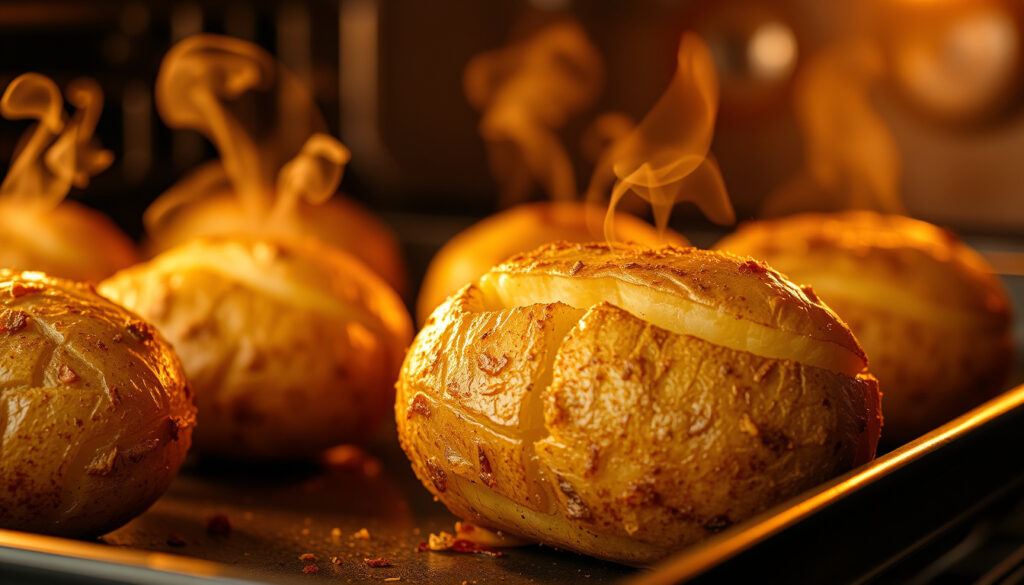
How to Bake Potatoes in Oven for Crispy Skin
There’s something oddly satisfying about pulling a perfectly baked potato out of the oven — crisp skin that crackles under a fork, a fluffy interior that soaks up butter like a sponge. Getting that ideal result comes down to a few science-backed decisions: temperature, time, and whether you reach for the foil. Once you understand the evidence behind each step, you’ll never have to guess again.
Ideal oven temperature: 425°F (220°C) ·
Average baking time: 50-60 minutes ·
Internal doneness: 205-210°F (96-99°C) ·
Best potato variety: Russet potatoes
Quick snapshot
- Poking holes prevents steam buildup and bursting (Love and Lemons (established recipe blog))
- Baking at high temperature (425°F+) creates crispy skin (Gimme Some Oven (specialist recipe site))
- Foil wrapping results in softer skin (Love and Lemons)
- Russet potatoes give best texture (Oh Sweet Basil (food blog))
- Exact baking time depends on potato size and oven calibration (Savory Experiments (recipe developer))
- Whether foil is necessary for even cooking (Tamara Ray Recipes (specialist baking site))
- Optimal temperature for both crispiness and fluffiness may vary by oven (Reddit r/Cooking (community discussion))
- Total time: 50-75 minutes (prep 5 min + baking 45-70 min) (Love and Lemons)
- Check doneness at 45 minutes; larger potatoes need up to 75 minutes (Oh Sweet Basil)
- Classic toppings: butter, sour cream, chives (Vegetable Recipes (recipe aggregator))
- Low-glycemic options for diabetics: smaller portions, fiber-rich toppings (American Diabetes Association (official health body))
Seven key metrics, one pattern: the difference between a mediocre and a stellar baked potato often comes down to small preparation choices that affect moisture and heat transfer.
| Factor | Value |
|---|---|
| Potato type | Russet |
| Oven temperature | 425°F (220°C) |
| Baking time | 45-60 min |
| Internal temperature | 205-210°F |
| Calories per medium potato | ~168 |
| Skin texture with foil | Soft |
| Skin texture without foil | Crispy |
What is the best way to bake a potato in an oven?
Choosing the right potato
- Russet potatoes (Idaho) have high starch content, yielding a fluffy interior after baking (Oh Sweet Basil (food blog))
- Waxy potatoes (red, Yukon Gold) stay dense and creamy — better for roasting or boiling
- Medium Russets (6-8 oz) balance cooking time and portion size
Choosing a waxy potato for baking is like using a sledgehammer for a finishing nail — the starch profile simply doesn’t deliver the airy fluff you expect from a classic baked potato. Stick with Russets and your guests will thank you.
Preheating the oven
- Set oven to 425°F — the most common temperature across top recipe sources (Love and Lemons (established recipe blog))
- At 400°F, times stretch to 45-70 minutes depending on size (Savory Experiments (recipe developer))
- At 450°F, skin crisps faster — the method recommended by many for extra crunch (Gimme Some Oven (specialist recipe site))
- Always preheat fully; an inconsistent start leads to uneven cooking
Piercing the skin
- Using a fork, pierce each potato 6-8 times all over (Love and Lemons)
- This releases steam as the potato bakes, preventing burst skins (The Kitchn (home cooking resource))
- Forgetting to pierce can cause a messy explosion — the steam has nowhere to go
Oil and seasoning
- Rub each potato with about 1 teaspoon of oil (olive or avocado) (Vegetable Recipes (recipe aggregator))
- Generously season with salt right after oiling — this creates a seasoned crust
- Dry the skin thoroughly before oiling: moisture is the enemy of crispness (Instagram (home cook demonstration))
Baking to perfection
- Place directly on oven rack or on a parchment-lined baking sheet (Love and Lemons)
- Bake at 425°F for 45-60 minutes, until fork-tender (Love and Lemons)
- For even cooking, flip potatoes every 20 minutes (The Kitchn)
- Internal temperature target: 205-210°F (96-99°C) for optimal fluffiness
How long do baking potatoes take to cook in the oven?
Baking time at 400°F
- Medium potatoes (6-8 oz) typically take 45-55 minutes (Savory Experiments (recipe developer))
- Large potatoes (10-12 oz) need 60-70 minutes
Baking time at 425°F
- Standard size: 45-60 minutes (Love and Lemons (established recipe blog))
- Small potatoes: 35-45 minutes
Baking time at 350°F
- Standard potatoes: about 60 minutes (Oh Sweet Basil (food blog))
- Large potatoes: up to 75 minutes
- Lower heat can still yield crispy skin if you bake longer and skip foil
How to check for doneness
- A fork should slide in with little resistance — that’s the fork-tender test (Love and Lemons)
- An instant-read thermometer reading 205-210°F confirms perfectly cooked interior
- Squeeze gently with an oven mitt — a done potato yields slightly
Do you wrap your baked potato in foil?
Pros of wrapping in foil
- Traps steam, keeping the exterior soft and the interior moist (Love and Lemons (established recipe blog))
- Useful for holding potatoes warm after baking (wrapping then unwrapping before serving)
- Some methods use foil for even heat distribution though evidence is mixed
Cons of wrapping in foil
- Softens the skin — exactly what you don’t want if crispiness is the goal (Love and Lemons)
- Can lead to soggy skin and longer cooking times
- Reduces the browning reaction that produces flavor compounds
How to achieve crispy skin without foil
- Bake unwrapped at 425°F or higher (Gimme Some Oven (specialist recipe site))
- Ensure skin is completely dry before oiling
- Score the skin with a knife after baking to release steam (optional) (Gimme Some Oven)
The catch: foil serves one purpose — moisture retention — but at the direct cost of texture. If you value a crackling crust that holds toppings, skip the foil entirely.
Do I need to poke holes in potatoes before baking?
Why poking holes prevents bursting
- Potatoes contain water that turns to steam during baking; without an escape, pressure builds up and can cause the potato to explode (The Kitchn (home cooking resource))
- Poking creates steam vents — a simple safety measure
How to poke holes properly
- Use a fork or a small knife; pierce all sides 6-8 times (Love and Lemons (established recipe blog))
- Pierce deep enough to reach the center — shallow pricks won’t release steam effectively
- Space holes evenly for consistent venting
What happens if you forget to poke
- Potatoes can burst in the oven, creating a mess and uneven cooking (Start Cooking (cooking instruction site))
- Burst potatoes dry out faster because the skin ruptures, letting interior moisture escape
- It’s rare but possible — the risk is not worth skipping the step
A burst potato isn’t just a messy oven — it’s a ruined meal. The hole-poking step takes ten seconds and costs nothing. Every time you skip it you gamble 50+ minutes of cooking time on a single puncture, and that’s a bet with poor odds.
What are common potato baking mistakes?
Skipping the pierce step
- Risk of explosion and uneven texture (Start Cooking (cooking instruction site))
- Potatoes may cook unevenly as pressure pockets form
Using the wrong potato variety
- Waxy potatoes produce a glue-like interior rather than fluff (Oh Sweet Basil (food blog))
- Starchy Russets or Idahos are the only reliable choice for classic baked potatoes
Not preheating the oven
- Cold oven extends cooking time unpredictably (Savory Experiments (recipe developer))
- Skin will not crisp properly if the oven temperature ramps slowly
Overcrowding the baking sheet
- Potatoes need space for hot air to circulate; crowding traps steam against the skin (The Kitchn (home cooking resource))
- Use a single layer with at least 2 inches between each potato
Undercooking or overcooking
- Undercooked potatoes have dense, hard centers (Love and Lemons (established recipe blog))
- Overcooked potatoes lose moisture and become tough or dry
- Use a fork test or thermometer (205-210°F) to hit the sweet spot
The trade-off: every mistake is a flavor-killer, but they’re also all preventable. Temperature control and spacing cost nothing; choosing the right potato and piercing the skin adds two minutes of prep. The pattern is clear — shortcuts trade convenience for quality every time.
Step-by-step guide: How to bake potatoes in oven
- Preheat your oven to 425°F (220°C). Place a rack in the center.
- Select and prepare potatoes. Choose medium Russet potatoes (6-8 oz each). Scrub them clean and dry thoroughly with a paper towel.
- Pierce each potato 6-8 times with a fork — all sides, deep enough to reach the center.
- Oil and season. Rub about 1 teaspoon of olive or avocado oil over each potato. Sprinkle coarse salt evenly over the oiled skin.
- Bake unwrapped on the oven rack or a parchment-lined baking sheet. For even cooking, flip the potatoes every 20 minutes.
- Check for doneness at 45 minutes. Insert a fork — it should slide in easily. For precise measurement, internal temperature should read 205-210°F (96-99°C).
- Serve immediately. Split open with a knife, fluff the interior with a fork, and add desired toppings.
What the evidence says
Confirmed facts
- Poking holes prevents steam buildup and bursting (The Kitchn (home cooking resource))
- Baking at high temperature (425°F+) creates crispy skin (Love and Lemons (established recipe blog))
- Foil wrapping results in softer skin (Love and Lemons)
- Russet potatoes give best texture (Oh Sweet Basil (food blog))
- Preheating the oven is essential for even cooking (Savory Experiments (recipe developer))
- Oiling and salting the skin enhances crispness and flavor (Vegetable Recipes (recipe aggregator))
- Internal temperature of 205-210°F indicates doneness (multiple sources)
- Direct placement on oven rack promotes even heat distribution (Start Cooking (cooking instruction site))
What remains unclear
- Exact baking time depends heavily on potato size and oven calibration — no single time works for all (Savory Experiments)
- Some cooks report success with foil wrapped around part of the potato (steering a middle course) but evidence is anecdotal (Tamara Ray Recipes)
- The optimal temperature for achieving both crispy skin and fluffy interior may vary by oven model (Reddit r/Cooking (community discussion))
Expert perspectives
After testing multiple temperatures, we found that 425°F is the ideal temperature for a tender, fluffy interior and golden, crispy skin. We don’t wrap our potatoes in foil because foil traps steam and makes the skins soft and soggy.
— Love and Lemons (food blog with tested recipes)
For extra-crispy skin, skip the foil. You might also try scoring the skin with a sharp knife before baking to allow more steam to escape — it helps the skin get even crunchier.
— Gimme Some Oven (specialist recipe site)
Potatoes can be part of a healthy eating plan if you watch your portion size. Choose smaller potatoes and top them with vegetables, beans, or a little low-fat cheese. The fiber from the skin and toppings helps blunt the blood sugar response.
— American Diabetes Association (official health body)
The decision to skip foil and bake at 425°F is supported by nearly every tested recipe source. For the home cook who wants a reliable outcome, that combination delivers the highest chance of crisp skin and fluffy interior. For someone managing blood sugar, the same method works — just cut the portion and load up on fiber-rich toppings. The evidence is consistent: temperature rules, foil softens, and the only real variable you can’t control is potato size. For the Dublin cook who wants dinner on the table without guessing, that’s a clear path: 425°F, no foil, and a fork-pierced Russet. The trade-off is minor prep time for a major texture payoff.
Related reading: Easy Apple Crumble Recipe – Quick Foolproof Dessert · Peking Duck Near Me Dublin: Prices, Portions & Top Spots
For perfectly crispy skin and a fluffy interior, you can also refer to our detailed guide on how to bake potatoes in oven.
Frequently asked questions
Can diabetics eat baked potatoes?
Yes, but portion control matters. A medium baked potato (about 168 calories) can fit into a diabetes-friendly diet if paired with protein, fiber, and healthy fats. The American Diabetes Association recommends small portions and toppings like veggies, beans, or low-fat cheese to slow glucose absorption.
How to reduce blood sugar spike from baked potatoes?
Eat the skin (fiber), add a source of protein or healthy fat (butter, sour cream, cheese, or beans), and avoid eating potatoes as the sole item. Cooling the potato after baking also increases resistant starch, which reduces glycemic impact.
Can you bake potatoes in an air fryer?
Yes. Preheat the air fryer to 400°F, pierce the potato, oil and season, then cook for 35-45 minutes depending on size. Air fryers circulate hot air more efficiently than ovens, so skin gets crisp faster.
How to reheat a baked potato?
Reheat in a 350°F oven for 10-15 minutes to restore crispness. Microwaving works but will soften the skin. For best results, split the potato open, add a pat of butter, and reheat in the oven.
Is baked potato skin healthy to eat?
Yes — the skin contains fiber, potassium, and vitamin C. Eating the skin adds texture and nutrients. Just scrub it thoroughly before baking.
What oil is best for coating potatoes before baking?
Olive oil and avocado oil work well because of their high smoke points (above 400°F). Vegetable oil or canola oil are also fine. Avoid butter for coating — it burns at baking temperatures.
More related posts
 Dublin to Sydney Flights: No Direct, Best Routes & Cheap Tips
 Ireland Social Welfare Payment Dates: Christmas Bonus 2025
 Early Social Welfare Payment Ireland 2026: Bank Holiday Dates
 US to UK Shoe Size: Women’s and Men’s Conversion Guide
 Euromillions Plus Winning Location – Irish Retailer for €250M Jackpot
 Munster Hurling Championship 2025 Fixtures: Schedule & Results
