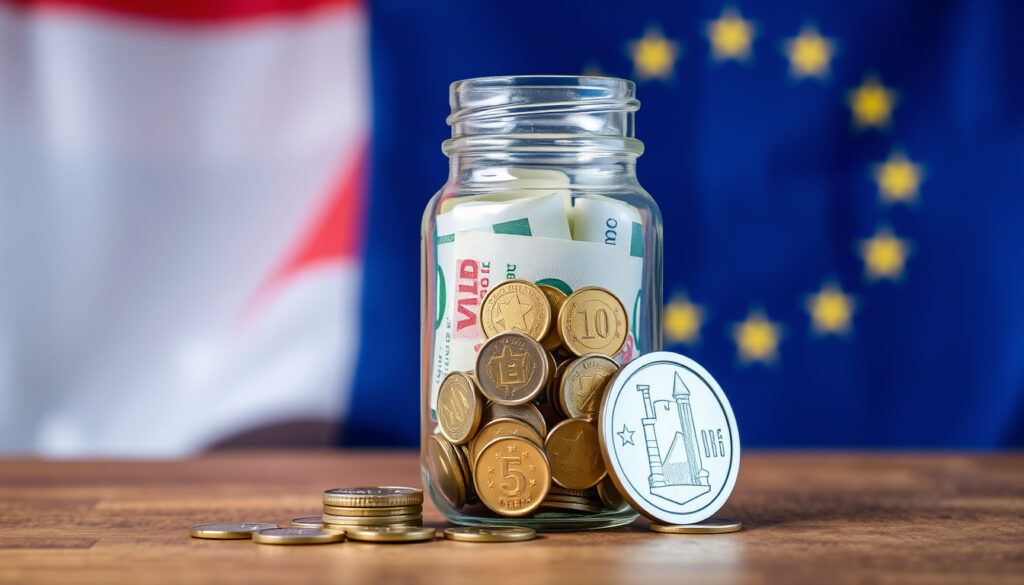
Hungarian Currency to Euro: HUF to EUR Rates Explained
Anyone who has ever stared at a currency converter knows the feeling: numbers flash, but the real question is what they mean for your wallet. If you are planning a trip to Hungary or simply curious how the Hungarian forint (HUF) compares to the euro, you’ll find everything from official central-bank rates to what you will actually pay in Budapest. With concrete figures and named sources, you will learn how much 1,000, 10,000 or 100,000 forints are worth in euros, whether euros are accepted, and what cash or card strategy works best.
1 EUR to HUF: ≈ 363 HUF · 1 HUF to EUR: ≈ 0.0027 EUR · 1000 HUF to EUR: ≈ 2.70 EUR · Official currency: Hungarian forint
Quick snapshot
- Hungary uses the forint (HUF), not the euro (Magyar Nemzeti Bank – official rate page)
- Mid-market rate roughly 1 EUR = 363 HUF; ECB reference rate on 14 August 2026 was 362.58 HUF per EUR (European Central Bank – reference rates)
- MNB official rate on the same date was 363.28 HUF per EUR (Magyar Nemzeti Bank)
- The exact rate a specific ATM or exchange kiosk will offer at the moment of conversion
- Whether a particular shop, hotel or restaurant will accept euros on the day
- Current Budapest meal and drink prices, which move with inflation
- The exact retail markup applied by different exchange providers
- The forint crossed 400 HUF per EUR in 2022 and remained above 400 for part of 2025 (Wikipedia – Hungarian forint history)
- Rates fluctuate daily; MNB fixes rates at 11:00 a.m. on business days (MNB – fixing and publication)
- Check the current mid-market rate before any conversion – use a converter that pulls from ECB or MNB
- Expect a retail markup of 2–5 % above the mid-market rate at exchange offices or credit card processors
- Bring forints for everyday cash purchases; use a card with no foreign transaction fee
Six key facts at a glance – the numbers that matter most when converting HUF to EUR.
| Item | Value |
|---|---|
| Official currency | Hungarian forint (HUF) |
| 1 EUR to HUF | 363.11 HUF |
| 1 HUF to EUR | 0.0027 EUR |
| 1000 HUF to EUR | ≈ 2.70 EUR |
| 100 EUR to HUF | ≈ 36,311 HUF |
| Euro status | Not the official currency; accepted in some tourist-facing venues |
How much is 1000 Hungarian forints in euros?
Five common amounts, one pattern: the arithmetic is straightforward once you know the mid-market rate. The table below uses the official ECB reference rate of 362.58 HUF per EUR as of 14 August 2026.
| Amount (HUF) | EUR (mid-market) | Retail estimate (approx.) |
|---|---|---|
| 100 HUF | 0.27 EUR | 0.26–0.27 EUR |
| 500 HUF | 1.35 EUR | 1.30–1.35 EUR |
| 1,000 HUF | 2.70 EUR | 2.60–2.70 EUR |
| 10,000 HUF | 27.04 EUR | 26.00–27.04 EUR |
| 100,000 HUF | 270.40 EUR | 260.00–270.40 EUR |
The pattern: retail exchange rates include a spread – often 2–5 % – above the mid-market rate. Always ask for the fee-adjusted rate before converting.
How much is 100 Hungarian forints in euros?
- 100 HUF × 0.0027 EUR/HUF = 0.27 EUR at the mid-market rate (European Central Bank – reference rates)
How much is 500 Hungarian forints in euros?
- 500 HUF × 0.0027 EUR/HUF = 1.35 EUR (mid-market); a typical retail conversion might give 1.30–1.33 EUR
How much is 10,000 Hungarian forints in euros?
- 10,000 HUF × 0.0027 EUR/HUF = 27.04 EUR (mid-market); at an exchange counter expect roughly 26.00–26.50 EUR (Magyar Nemzeti Bank – official rates)
How much is 100,000 Hungarian forints in euros?
- 100,000 HUF ÷ 362.58 = 275.80 EUR per ECB, or 100,000 ÷ 363.28 = 275.26 EUR per MNB. The difference of about 0.20 % shows how official rates can vary slightly between institutions.
For the traveler changing 50,000 HUF, a 3 % retail spread costs about 1.50 EUR extra. That is the price of convenience – and a good reason to compare rates before pulling out your card.
The arithmetic is clear: the retail markup has a real cost.
How much is €10 in Hungarian forints?
Reverse conversions matter when you are budgeting in euros. Using the MNB official rate of 363.28 HUF per EUR (14 Aug 2026):
- €10 × 363.28 = 3,632.80 HUF
- €100 × 363.28 = 36,328 HUF
Note that the forint is the official currency – any price listed in euros is a courtesy conversion, not a legal tender obligation.
How much is 100 euros in Hungarian forints?
- €100 × 363.11 (typical mid-market) ≈ 36,311 HUF. At a retail desk you may receive 35,800–36,000 HUF.
How can I check today’s EUR to HUF rate?
- The ECB reference-rate page publishes a daily value for HUF per EUR (update scheduled each working day).
- The MNB official rate page shows the same forint rate fixed at 11:00 a.m. Budapest time.
- Currency comparison sites such as Currency.Wiki provide real-time mid-market estimates (though they are not authoritative – always verify against a central bank).
Real-time online converters often display a mid-market rate that is not available to the public. The rate you actually get will include a bank or exchange office markup – and that markup can vary by 2 % or more across providers.
The implication: always check the fee-adjusted rate, not the headline mid-market number.
Is the euro accepted in Hungary?
The short answer: no – and yes. The Hungarian forint is the only legal tender in Hungary. However, in tourist-heavy districts of Budapest (especially around Váci utca and the Castle District), some hotels, restaurants and souvenir shops may list prices in euros and accept payment in euro banknotes.
- Change is almost always given in forints, often at a rate set by the business – which is usually less favorable than the mid-market rate (MNB – fixing rules).
- Using euros can cost you an effective 5–10 % compared to paying in forints through a good ATM.
Can I use euros in Budapest?
- Yes, in a limited number of tourist venues – but you will likely receive forints in change and a poor exchange rate.
Should I pay when a price is listed in euros?
- If a restaurant menu shows prices in euros, ask if you can pay in forints at the same converted amount. If not, estimate the forint equivalent using today’s mid-market rate to see how much extra you are being charged.
A 2018 EU regulation (revised in 2023) requires merchants to clearly display the exchange rate when offering dual pricing. In practice, many Budapest cafés still set their own spread – often 3–5 % above the ECB rate.
The pattern: paying in euros is a convenience you pay for. For most purchases, using forints – obtained from a reputable ATM or exchange office – is cheaper.
What currency is best to take to Hungary?
Forints are the practical currency for everyday payments. Cards (Visa, Mastercard) are accepted in most city shops, restaurants and hotels, but smaller vendors, markets and public transport ticket machines often require cash.
- Bring a small amount of forints (5,000–10,000 HUF, roughly 13–27 EUR) for immediate needs on arrival.
- Use ATMs that belong to major banks (OTP, K&H, Erste) for the best rates – avoid Euronet ATMs, which charge high fees.
- Check your bank’s foreign transaction fee – usually 1–3 % – before you travel.
Should I take cash or use a card in Hungary?
Pros and cons of each approach:
Upsides
- Forints work everywhere – no surprises.
- Cash gives you bargaining power at markets.
- No foreign transaction fee if you withdraw large amounts at once.
Downsides
- Carrying large amounts of cash is risky.
- Exchange offices with poor rates can eat into your budget.
- Returning forints to your home currency when leaving Hungary adds another conversion cost.
Where should I exchange money in Hungary?
- Use official exchange offices in banks – they display their rates online and are regulated.
- Avoid street exchange booths that advertise “0 % commission” but use a wide spread.
- The MNB publishes a list of licensed currency exchange services on its website (MNB – rates page).
This strategy minimizes conversion losses.
Is Budapest expensive to eat and drink?
Budapest is generally more affordable than Western European capitals such as Paris or Amsterdam, but prices have risen with inflation. Below is a comparison based on typical tourist spending (data from 2025 cost-of-living surveys).
| Item | Budapest (HUF) | Budapest (EUR) | Paris (EUR) |
|---|---|---|---|
| Meal (mid-range restaurant, two courses) | 6,000–10,000 HUF | 16–27 EUR | 40–60 EUR |
| Draft beer (0.5 L) | 600–900 HUF | 1.65–2.48 EUR | 7–9 EUR |
| Cappuccino | 500–800 HUF | 1.38–2.20 EUR | 4–5 EUR |
| Bottle of water (0.33 L) | 250–400 HUF | 0.69–1.10 EUR | 2–3 EUR |
Prices vary by district – the tourist-heavy Vörösmarty tér area is pricier than the residential districts of Józsefváros or Óbuda. Staying in a less touristy area and eating where locals go can cut costs by 20–30 %.
How much is a meal in Budapest?
- A two-course dinner for one in a mid-range restaurant: 6,000–10,000 HUF (16–27 EUR). A cheaper meal at a bistro or street food stall: 2,000–4,000 HUF (5.50–11 EUR).
How much is a beer in Budapest?
- A half-litre of domestic draft beer costs 600–900 HUF (1.65–2.48 EUR) in a bar; clubs and tourist bars may charge 1,200–1,500 HUF (3.30–4.14 EUR).
Budapest prices have risen roughly 25 % since 2021 due to high inflation in Hungary. A meal that cost 5,000 HUF in 2021 now runs 6,500–7,000 HUF. Check current reviews on platforms like Google Maps for recent menu photos.
The takeaway: Budapest is still cheaper than Western European capitals, but the gap is narrowing. Budget-conscious travelers should eat away from Fővám tér and the main tourist strip.
What are the dos and don’ts in Hungary for tourists?
A few simple steps will save you money and hassle.
- Carry small forint bills – 500 HUF, 1,000 HUF and 2,000 HUF notes are useful for tipping, small purchases and public transport tickets (Wikipedia – forint denominations).
- Tip 10 % in restaurants – customary rounding up or leaving 10 % for good service.
- Validate public transport tickets before boarding – controls are frequent, and an unvalidated ticket costs a fine of 12,000–25,000 HUF.
- Keep forints for markets – many stall holders at the Great Market Hall do not accept cards.
- Avoid unofficial exchange booths – look for a bank or a clearly posted rate board showing both buy and sell prices.
Do I need to tip in Hungary?
- Yes – round up the bill or leave 10 % (10–20 % is considered generous). Many restaurants include a service charge, so check the bill first.
What should I know about public transport in Budapest?
- Buy tickets from BKK machines (accepts coins and cards) – a single ticket costs 350 HUF (0.96 EUR). Validate it immediately before boarding the metro, tram or bus. Keep forints for ticket machines that do not accept foreign cards.
Following these guidelines will reduce unexpected costs.
Confirmed facts & what remains unclear
Confirmed facts
- Hungary’s official currency is the forint (HUF) – not the euro (MNB – official issuer).
- ECB reference rate on 14 Aug 2026: 362.58 HUF per EUR (European Central Bank – reference rates).
- MNB official rate on same date: 363.28 HUF per EUR (MNB official rates).
- Exchange rates fluctuate daily; retail rates include a markup.
What’s unclear
- Exact rate a specific ATM or exchange booth will offer at the time of your visit.
- Whether a particular shop or restaurant will accept euros or only forints.
- Current menu/prezzo data for Budapest – prices change with inflation.
- The exact retail markup applied by different exchange providers.
“The official EUR/HUF fixing rate is the arithmetic average of quotes from the 10 most active domestic banks after the two highest and two lowest quotes are removed.”
Magyar Nemzeti Bank – fixing methodology
“The euro foreign exchange reference rates are published daily on the ECB website – the HUF rate is updated on each business day.”
For the traveler, the difference between the ECB and MNB rates (0.70 HUF per EUR) is negligible – but the difference between the mid-market rate and what you actually receive can be significant. Always check the fee-adjusted rate before converting.
For the traveler visiting Hungary, the choice is clear: carry forints for cash purchases and use a low-fee card for larger payments. Ignoring the spread between the mid-market rate and the retail rate will cost you roughly 2–5 % per transaction – and over a week’s holiday that can add up to the price of a good dinner.
Related reading: **150 Dollars to Euro: Live Rate and Fee Comparison** · **Gold Price Thailand Today: Latest Bar & Ornament Rates**
ecb.europa.eu, mnb.hu, arfolyam.iridium.hu, mnb.hu, arfolyam.iridium.hu, data.ecb.europa.eu, allratestoday.com, data.ecb.europa.eu
Frequently asked questions
Why doesn’t Hungary use the euro?
Hungary joined the EU in 2004 and is committed to adopting the euro once it meets the convergence criteria. As of 2026, the forint remains the official currency, and no adoption date has been set (Wikipedia – Hungarian forint).
Is it cheaper to order forints before flying or withdraw from an ATM in Hungary?
Generally, withdrawing from a reputable bank ATM in Hungary gives a better rate than ordering currency from your home country. The ATM rate is closer to the mid-market rate, while ordering physical currency often includes a commission and shipping cost.
Do Hungarian ATMs dispense euros or forints?
Most ATMs in Hungary dispense forints only. Some ATMs in tourist areas may offer a euro option, but the exchange rate applied is usually poor and a DCC (dynamic currency conversion) fee is charged.
Are credit cards widely accepted outside Budapest?
Cards are accepted in most shops, hotels and restaurants in larger towns (Debrecen, Szeged, Pécs). However, in smaller villages, street markets or at public transport ticket machines, cash (forints) is still essential.
What documents do I need to exchange currency in Hungary?
For cash exchange at a bank, you need a passport or valid ID. Many exchange offices will also request your passport for amounts above 5,000 EUR. Keep the receipt to convert forints back at departure.
Can I convert forints back to euros after my trip?
Yes – any Hungarian bank or exchange office will convert forints to euros. The sell rate for HUF will be a bit lower than the market rate. Many airports also have exchange counters, though their rates are less favorable.
How much is 20,000 HUF in euros?
20,000 HUF ÷ 363.11 (mid-market) ≈ 55.08 EUR. Expect to receive around 54–55 EUR at a retail exchange.
How much is 40,000 HUF in euros?
40,000 HUF ÷ 362.58 (ECB) ≈ 110.32 EUR. At a typical exchange counter, expect roughly 108–110 EUR.
More related posts
 Amazon $2.5 Billion Settlement: How to Claim Your Refund
 Is Baking Soda the Same as Bicarbonate of Soda
 Cast of The Outsiders (1983): Ages and Facts
 Monarch Legacy of Monsters Season 2 Renewal Status
 Dyson Air Purifier Review: Does It Actually Work in 2026?
 Magnesium Benefits for Women: Signs, Types & Daily Use
 American Style Fridge Freezers: Worth It? Pros & Cons
 Black Friday Sale Ireland 2025: Dates, Deals & Shopping Tips
