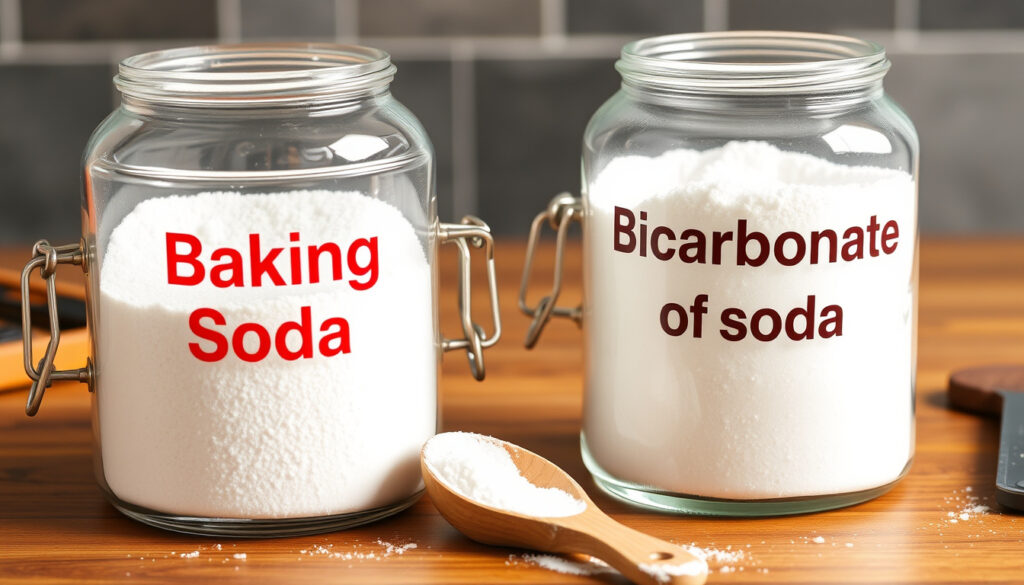
Is Baking Soda the Same as Bicarbonate of Soda
Baking soda and bicarbonate of soda are chemically identical — the same white powder sold under different names depending on where you live. But the naming confusion, regional variations, and safety questions around this common kitchen powder are worth unpacking.
Chemical identity: Sodium bicarbonate (NaHCO₃) ·Alternative names by region: Bicarb soda (UK, Australia); Baking soda (US); Bread soda (Ireland) ·Common uses in home: Baking, cleaning, deodorizing, oral care ·Dietary safety (FDA): GRAS (Generally Recognized as Safe) for limited consumption ·pH of solution: Approximately 8.1 (1% solution)
Quick snapshot
- Baking soda and bicarbonate of soda are chemically identical — both are sodium bicarbonate (Mayo Clinic (drug database))
- FDA classifies sodium bicarbonate as GRAS for food use (U.S. Food and Drug Administration (food additive database))
- Optimal daily dose for health benefits — no consensus exists
- Complete list of medication interactions (varies by drug class)
- Long-term safety of regular oral brushing with baking soda
- 1791 — French chemist Nicolas Leblanc produces sodium bicarbonate (Britannica)
- 1846 — Arm & Hammer baking soda company founded (Britannica)
- 1860s — Baking soda becomes common in US kitchens (Britannica)
- 1972 — First use as toothpaste (Arm & Hammer formula) (Britannica)
- Growing interest in natural cleaning alternatives drives baking soda demand
- Medical research exploring baking soda’s role in kidney health and cancer treatment
- More dental authorities likely to address enamel abrasion risks formally
The table below shows what’s in your box — and what’s not.
| Attribute | Baking Soda / Bicarbonate of Soda | Baking Powder | Washing Soda |
|---|---|---|---|
| Chemical name | Sodium bicarbonate (NaHCO₃) | Sodium bicarbonate + acid (cream of tartar) | Sodium carbonate (Na₂CO₃) |
| pH (1% solution) | 8.1 | 7.0–7.5 | 11.4 |
| Primary use | Leavening, cleaning, antacid | Leavening (no added acid needed) | Laundry booster, heavy cleaning |
| Edible | Yes (food grade, limited amounts) | Yes | No — toxic if ingested |
| FDA GRAS status | Yes (21 CFR 184.1736) | Yes | No |
| Acid needed for reaction? | Yes | No (self-contained) | No |
The pattern: three different products, three different potencies. The one you want for baking is sodium bicarbonate — anything stronger risks ruining your recipe or your health.
Is baking soda the same as bicarbonate of soda?
Yes — they are chemically identical. Both are sodium bicarbonate (NaHCO₃), a white crystalline powder that reacts with acids to produce carbon dioxide gas. This reaction is what makes dough rise and what creates the fizz when you mix it with vinegar for cleaning.
The Mayo Clinic confirms that “baking soda” and “bicarbonate of soda” are alternative names for the same substance.
Chemical identity of baking soda and bicarbonate of soda
Sodium bicarbonate is a simple salt made of sodium ions and bicarbonate ions. The chemical formula is NaHCO₃ — one sodium atom, one hydrogen atom, one carbon atom, and three oxygen atoms. When dissolved in water, it creates a mildly alkaline solution with a pH of about 8.1.
Regional naming differences: USA vs UK vs Ireland vs Australia
- United States: Baking soda (the commercial name popularized by Arm & Hammer since 1846)
- United Kingdom and Australia: Bicarbonate of soda (also called bicarb soda)
- Ireland: Bread soda (a direct reference to its use in traditional Irish soda bread)
- South Africa: Bicarbonate of soda or bicarb
- New Zealand: Baking soda or bicarbonate of soda
The trade-off: What you call it depends on where you learned to bake. But the box you grab from the shelf — whether labeled “baking soda” in New York or “bicarbonate of soda” in London — contains exactly the same compound.
A global chemistry textbook uses one name — sodium bicarbonate. But kitchen cupboards around the world stock it under at least five different labels. The naming game says more about marketing history than chemical reality.
What this means: The regional names reflect branding and tradition, not any difference in the product itself.
Is bicarbonate of soda edible?
Yes — but only if you’re buying food-grade product and consuming it in small, occasional amounts. Not all white powder in a box is safe to eat.
Food-grade vs cleaning-grade bicarbonate of soda
The U.S. Food and Drug Administration lists sodium bicarbonate as Generally Recognized as Safe (GRAS) for direct use as a food additive. This applies only to food-grade product. Industrial or cleaning-grade sodium bicarbonate may contain impurities or be processed with chemicals not approved for consumption. The same compound can be used as a general household cleaner, according to Chemical Safety Facts (industry safety resource) — but that doesn’t mean cleaning-grade powder is safe to eat.
GRAS status and safe dosage limits
Product labels for OTC antacid use instruct adults to dissolve 1/2 teaspoon of baking soda in a half glass of water every two hours, with a maximum of seven and a half teaspoons per day. Exceeding these amounts can lead to serious toxicity. The Poison Control (national poison center) warns that “excessive baking soda use can cause serious toxicity because sodium bicarbonate can generate a large volume of carbon dioxide in the stomach when swallowed.”
The implication: Food-grade baking soda is safe in small, measured doses. Treat it as a kitchen ingredient, not a daily health tonic.
Can I use bicarbonate of soda instead of baking soda?
Since they are the same chemical compound, you can substitute them 1:1 in any recipe or cleaning application. The confusion arises because many recipes call for “baking powder” — which is not the same thing.
- Check the recipe for an acidic ingredient (buttermilk, lemon juice, yogurt). Without acid, the reaction won’t happen.
- Use exactly the same amount of bicarbonate of soda as the recipe calls for baking soda.
- If substituting for baking powder, use three times the amount and reduce liquid accordingly.
Substitution in baking and cleaning
When a recipe asks for baking soda (or bicarbonate of soda) as a leavening agent, it needs an acid to react with — common pairings include buttermilk, lemon juice, yogurt, or cream of tartar. Without an acid, the sodium bicarbonate won’t release carbon dioxide, and your baked goods will fall flat. Baking powder already contains the acid (cream of tartar) mixed into the powder, so it can work with neutral liquids like milk or water.
Conversion ratios for baking recipes
- 1 teaspoon baking soda = 3 teaspoons baking powder (but you must adjust liquid)
- 1 teaspoon baking soda = 1 teaspoon bicarbonate of soda (identical)
- Baking soda substitute in cleaning: use the same powder directly
The baker who substitutes baking soda for baking powder without checking acidity ends up with metallic-tasting, flat biscuits. The cleaner who uses washing soda instead of baking soda on a delicate surface risks damage. Knowing which white powder is which saves both your recipes and your countertops.
The takeaway: Always check which white powder you’re using — substitution mistakes can ruin recipes or damage surfaces.
Can I brush my teeth with bicarbonate of soda?
Yes — and people have been doing it for decades. But there’s a trade-off between whitening power and enamel wear.
Effectiveness for whitening and plaque removal
Sodium bicarbonate works as a mild abrasive that physically scrubs surface stains from teeth. Its mild alkalinity also neutralizes acids produced by bacteria in the mouth, which may reduce the risk of cavities.
Risks of enamel abrasion and gum irritation
The Mayo Clinic provides caution about overuse. Case reports in medical literature describe enamel wear from long-term, high-abrasion brushing. The American Dental Association does not currently recommend daily brushing with pure baking soda powder — commercial ADA-approved toothpastes that contain baking soda also include other ingredients that reduce abrasiveness.
The catch: Occasional use may brighten your smile. Daily scrubbing with gritty powder may thin your enamel over a decade. Ask your dentist before making it a habit.
What are the risks of drinking baking soda water?
Drinking baking soda water has become a popular trend for indigestion relief and even athletic performance. But the risks go beyond an occasional burp.
Poison Control warns: “Excessive baking soda use can cause serious toxicity because sodium bicarbonate can generate a large volume of carbon dioxide in the stomach when swallowed.”
Interactions with medications
Taking baking soda within two hours of other medications can interfere with absorption or medication effects. Medications known to interact include:
- Antibiotics (especially tetracyclines)
- Diuretics (water pills)
- Blood pressure medications
- Aspirin and other salicylates
- Lithium
Health conditions where baking soda is unsafe
People with the following conditions should avoid baking soda ingestion without medical supervision:
- Kidney disease (impaired ability to excrete sodium and bicarbonate)
- Hypertension (high blood pressure) — one teaspoon contains about 1,250 mg of sodium
- Pregnancy — Medical News Today (health journalism) notes it is “not safe during pregnancy”
- Children under 6 — WebMD advises “do not give baking soda to a child under 6 unless a pediatrician tells you to”
Safe dosage and frequency of ingestion
The Poison Control documents case reports of serious toxicity from excessive use as an antacid. Chronic overuse can cause metabolic alkalosis — a dangerous condition where the blood becomes too alkaline. Keep doses below 1/2 teaspoon per serving and never exceed daily limits. If you need baking soda for indigestion more than twice a week, see a doctor.
The person who sips baking soda water daily for heartburn relief may mask a stomach ulcer or reflux condition that needs medical treatment. The sodium load also pushes blood pressure upward — exactly what hypertension patients need to avoid.
The bottom line: Risks outweigh benefits for many people — consult a doctor before regular use.
Is bicarbonate of soda good for cleaning?
Yes — it’s one of the most versatile non-toxic cleaning agents in a typical home. Its mild alkalinity and gentle abrasiveness make it useful for dozens of tasks.
Common household cleaning applications
- Sinks and tiles: Sprinkle on a damp sponge and scrub
- Ovens: Make a paste with water, apply to baked-on grease, let sit, then scrub
- Refrigerators: Open box absorbs odors
- Carpets and upholstery: Sprinkle, let sit 15 minutes, vacuum
- Shoes: Sprinkle inside overnight to deodorize
What not to mix with baking soda
Chemical Safety Facts notes the same compound can be used as a cleaner, but warns against mixing with:
- Vinegar: The fizzing reaction looks effective but mostly wastes both ingredients — use one or the other, not together in a closed container
- Bleach: Can produce toxic chlorine gas
- Strong acids: Can cause violent bubbling and splashing
What this means: Baking soda is a star cleaner when used solo. Mixing it with common household chemicals can create hazards instead of clean surfaces.
What is the same as baking soda?
Several substances share table space with baking soda but have very different chemical properties. Here’s what’s what.
List of alternative names
| Name | Chemical | Same as baking soda? |
|---|---|---|
| Bicarbonate of soda | NaHO₃ | Yes — identical |
| Bread soda | NaHO₃ | Yes — Ireland term |
| Bicarb | NaHO₃ | Yes — shorthand |
| Sodium bicarbonate | NaHCO₃ | Yes — chemical name |
| Baking powder | NaHCO₃ + acid | No — contains extra acid |
| Washing soda | Na₂CO₃ | No — stronger alkali |
| Cream of tartar | KHC₄H₄O₆ | No — pure acid |
| Potassium bicarbonate | KHCO₃ | No — different mineral |
The pattern: Three different products, three different potencies — know which to use where.
webmd.com, drugs.com, dailymed.nlm.nih.gov, pmc.ncbi.nlm.nih.gov, conncoll.edu, resources.healthgrades.com, poison.org, acibademinternational.com
Frequently asked questions
Is baking soda the same as baking powder?
No — baking powder contains baking soda plus an acid (cream of tartar) and a moisture absorber (cornstarch). The acid in baking powder reacts with the soda when liquid is added, creating bubbles. Baking soda needs a separate acid added to the recipe.
Can I use bicarbonate of soda for cooking if I have high blood pressure?
One teaspoon of baking soda contains about 1,250 mg of sodium — more than half the daily limit recommended for people with hypertension (2,300 mg). Occasional use may be safe, but daily ingestion is not recommended without medical guidance.
Does bicarbonate of soda expire?
Baking soda does not go bad, but it loses potency for baking over time as it absorbs moisture and carbon dioxide from the air. An unopened box lasts 2-3 years; once opened, use within 6 months for best leavening results. Test by adding a spoonful to vinegar — it should fizz vigorously.
Is baking soda safe for pets?
Small amounts of baking soda used for cleaning are generally safe around pets. However, ingesting large amounts can cause vomiting, diarrhea, and electrolyte imbalances in dogs and cats. Do not use baking soda as a DIY toothpaste for pets — use pet-formulated products.
Can I use baking soda to whiten my teeth?
Yes, but with caution. The mild abrasive action of baking soda can remove surface stains from coffee, tea, and wine. However, the American Dental Association does not recommend daily brushing with pure baking soda powder due to the risk of enamel abrasion. Commercial baking soda toothpastes include additional ingredients to reduce abrasiveness.
What is the difference between baking soda and washing soda?
Washing soda (sodium carbonate, Na₂CO₃) has one less hydrogen atom and one less oxygen atom than baking soda (sodium bicarbonate). This chemical difference makes washing soda much more alkaline — pH 11.4 vs 8.1 for baking soda. Washing soda is toxic if ingested and should not be used for baking. It’s best for laundry boosters, stain removers, and heavy cleaning.
Is bicarbonate of soda gluten free?
Yes — pure sodium bicarbonate is gluten free. It’s a simple chemical compound with no gluten-containing ingredients. However, always check the label on commercial baking soda boxes, as some brands may process products in facilities that also handle wheat. Look for a “gluten-free” label if you have celiac disease or gluten sensitivity.
How does baking soda work as a leavening agent?
When baking soda (a base) meets an acid (like buttermilk, lemon juice, or cream of tartar) and moisture, they react to produce carbon dioxide gas bubbles. These bubbles become trapped in the dough, causing it to rise. Without an acid, baking soda will not produce enough gas to properly leaven baked goods.
Related reading
- What Does Indigestion Feel like? Symptoms & Relief
- How to Remove Sauce Stains from Clothes and Surfaces
For the home baker in Ireland who calls it bread soda, the professional cleaner in the UK who buys bicarb by the kilo, and the American using baking soda for heartburn relief — the choice is simple: buy food-grade sodium bicarbonate, use it in measured amounts, and never confuse it with baking powder or washing soda. Your recipes, your teeth, and your blood pressure will thank you.
More related posts
 Smyths Toys for Girls: Best Gifts & Popular Toys for Every Age
 Limerick vs Clare 2025: Clare Win 3-20 at TUS Gaelic Grounds
 Vodafone Broadband Contact Number: Support in Ireland & UK
 St Patrick’s Athletic vs Waterford: Match Preview & Prediction
 Public Services Card Ireland 2025: How to Apply
 Dogs for Sale in Longford: Breeds, Tips & Where to Find
 The Iron Claw Cast Guide: Von Erich Brothers & True Story
 Medical Card Phone Number: HSE Contact & Renewal Guide
