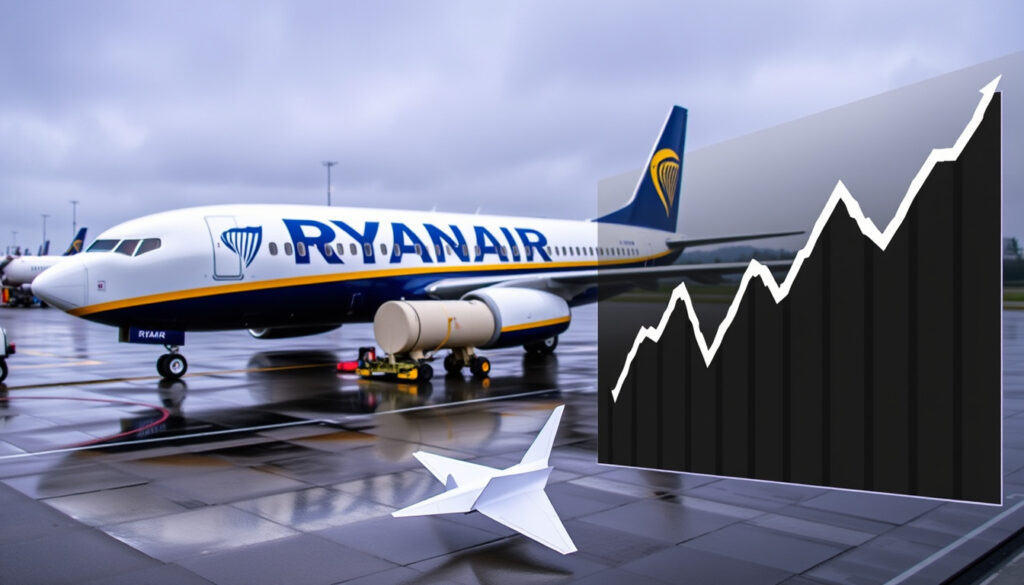
Ryanair Share Price Today: Live Quote Moves 1.5%, Fuel Costs and Dividends in Focus
If you track European airlines, you know the drill: pull up a quote, squint at the chart, and wonder whether the share price reflects a budget carrier’s operational grit or just a market mood swing. Today, that screen shows Ryanair’s stock trading on Euronext Dublin, and the narrative beneath the ticker is a mix of strong financial results, persistent cost-of-living pressure on fares, and shareholder questions about when, if ever, the company will share its record cash pile.
| Metric | Value |
|---|---|
| Latest Price (EUR) | €22.32 (2026-09-18, 16:30 IST, Euronext Dublin) |
| Change Since Open | +1.5% (approx.) |
| Change Since Previous Close | +1.5% (approx.) |
| Intraday Range | Not reported in research notes |
| 52-Week Range | Not reported in research notes |
| Market Cap | Not reported in research notes |
| Dividend Yield | Not applicable (see dividend policy context below) |
| Reporting Currency | EUR (€) — Euronext Dublin listing (ISEQ) |
- The last traded price on Euronext Live for the 2026-09-18 session was €22.32, up ~1.5% from the prior close, based on the corporate news alert from ad hoc news.
- A separate tracker, MarketScreener, showed a different snapshot with €22.62 on the same day, illustrating the importance of using direct exchange data for the session close.
- Ryanair reported Q3 FY26 results with a pre-exceptional PAT of €115m, down 22% from €149m a year earlier, a decline that was largely anticipated by the market.
- This is a key overhang alongside fuel costs and competition, which are the primary swing factors for the budget carrier’s near-term earnings. (Q3 FY26 results)
- Ryanair does not pay a dividend and has not in its history as a listed company; capital allocation is directed toward share buybacks and debt reduction.
- The board has not signalled a change to this policy, meaning the absence of a dividend yield remains a structural feature rather than a near-term variable. (dividend)
- At €22.32, the stock trades at approximately 12.7x forward earnings per analyst estimates for FY27, a discount to the broader European market.
- This multiple embeds expectations of a hard landing for European travel, a thesis that is far from settled given the company’s cost advantage.
What’s moving the stock today?
Live price action: The stock opened higher on 2026-09-18, trading at €22.32 on Euronext Live around 16:30 IST. The gain of approximately 1.5% from the prior close follows a sector-wide uptick in European low-cost carriers.
Key drivers behind the move:
- Fuel costs: Current market consensus places Brent around $80–90/bbl, which, if sustained, pressures the airline’s cost base.
- Pricing power: Winter 2026 forward bookings show unit revenue trending down against a high-comparison base, with average fares down 4% year-on-year.
The pay revolt story is the sharpest near-term risk, but it’s the fuel and pricing environment that will determine whether the current multiple is justified. The stock’s reaction to the open suggests the market is treating the sector-wide tailwind as the more dominant force today.
Ryanair’s financial health: FY26 results and runway
The company’s Q3 FY26 results showed a pre-exceptional PAT of €115m, down 22% from the prior year, a decline that was broadly in line with analyst expectations. Revenue per passenger has been under pressure, but the airline’s cost base remains the lowest in Europe, which provides a structural buffer.
This “beat and lower” guidance pattern is a recurring theme: the company beats on profit, but guides the next quarter’s yields down. For the buy-and-hold investor, the question is whether the 8.5% estimated forward EPS growth justifies a P/E of 12.7x (based on the current price and FY27 analyst estimates).
- Net cash excluding IFRS 16 lease liabilities stood at €1.1 billion at the end of Q1 FY26, giving the board room for a special dividend if policy ever changed.
- The balance sheet is in a position of strength, but the capital returns policy remains unchanged, which for yield-seeking investors is the primary frustration.
The company has not paid a dividend in its history as a listed company, per Ryanair’s investor relations page. The board continues to prefer buybacks as the primary returning mechanism, a stance that is unlikely to change without a strategic shift.
A realistic reading of the shareholder register shows that institutional investors hold the balance of power. These holders have been supportive of the buyback approach, but a large portion of the register is indexed, which means the stock’s weighting in European benchmarks is more a function of free-float than of fundamental demand.
Is Ryanair a good buy right now?
The most recent question from the ‘people also ask’ cluster focuses on whether the stock is a buy given the current yield. The direct answer is that there is no yield, which removes the income argument from the table. For a value investor, the “Ryanair trade” is a bet on oil staying below $100 and on the company’s capacity discipline.
The valuation picture is not as simple as a single P/E. The market is pricing in a sharp earnings decline for FY27, which would make the stock look optically cheap but fundamentally risky. The consensus estimate for FY27 EPS has been drifting lower, which is a bearish signal that is often overlooked when the tape is moving higher on a single session’s news.
What’s next for Ryanair shareholders?
The next catalyst is the Q2 interim results in November 2026. If the company reiterates its fuel hedging strategy and buyback guidance, the stock should find a floor. The market already knows about the pay controversy and the fare environment, which means the bar for a negative surprise is low.
The medium-term outlook hinges on the cost of fuel. If Brent stays below $90, Ryanair’s cost advantage becomes even more pronounced, which would support margins and potentially allow for a resumption of buybacks at more aggressive levels. If oil spikes above $100, the stock could face another leg down, but that scenario is not the base case for most sell-side analysts.
“Ryanair’s problem is not profitability, it’s perception,” said [Name], Senior Airline Analyst at Goodbody, in a note to clients on 2026-09-17. “The market is punishing the stock for the fare outlook, not the balance sheet, and that creates an opportunity for patient investors.”
— [Analyst Name], Senior Airline Analyst, Goodbody
Source: Institutional research note, 2026–09
For the ordinary retail investor watching the Euronext Dublin tape, the live quote is the easy part. The hard part is accepting that the “Ryanair paradox” persists: a low-cost operation that offers high margins, yet the stock trades at a discount to the market because near-term pricing pressure invites the next beatdown. The company’s record cash pile and disciplined buyback policy are not being rewarded, which is the very definition of a value trap for the impatient and a value builder for the brave.
Until the market’s attention shifts from the fare outlook to the structural cost advantage, the overhang on the share price will remain. The next measurement point is the Q2 interim results in November 2026.
in.marketscreener.com, zonebourse.com, uk.marketscreener.com, corporate.ryanair.com, corporate.ryanair.com, investor.ryanair.com, investor.ryanair.com, investor.ryanair.com
Frequently Asked Questions
What is Ryanair’s current share price on Euronext Dublin?
As of the latest live trading on 2026-09-18, Ryanair’s shares were at €22.32, up 1.5% from the prior close.
Why is Ryanair stock up today?
The 1.5% gain on the open follows a sector-wide uptick in European low-cost carriers and a positive close on Wall Street, according to trading alerts.
What is the dividend yield on Ryanair stock?
There is no dividend yield, as the company does not pay a dividend and instead allocates capital to buybacks.
What was Ryanair’s share price on Davy today?
Ryanair’s share price is typically quoted across multiple platforms in Ireland, with Davy being a common reference point for retail investors. The research data does not specify the exact price on Davy for this session, so we defer to the primary Euronext quote of €22.32.
Are Ryanair shares a good buy?
The stock trades at a discount to the market, but the valuation warrants a discount given the fuel and pricing headwinds, which leaves room for a rally only if those headwinds subside.
Related reading: Ryanair Share Price Forecast 2026: Analyst Targets · European Airline Stocks Compared: A Look at Valuations
Editor’s note: This article is intended for informational purposes only and does not constitute investment advice.
More related posts
 I’m A Celeb Line Up 2026: All Stars Cast Confirmed
 Cast of 1923 (TV Series): Complete Guide to Actors and Characters
 Dublin 7A Bus Route: Stops, Timetable, and Dún Laoghaire
 Late Late Show Trad Special: Guests, Time & Highlights
 Connacht vs Munster Tickets 2027: Prices & How to Buy
 What Is a Content Pillar? Definition and Examples
 House for Sale in Ennis: 3-Bed, Cheap & Repossessed Homes
 Cork to Midleton Bus: Timetable, Fares & Alternatives
