Extreme Weather Risk Spain: Floods & Safety Guide
If you’ve been watching the headlines from Spain, the weather story is hard to miss. Flash floods, blistering heatwaves, and wildfire warnings are becoming routine – and the official alert system is buzzing. This guide cuts through the noise to show you what’s actually happening, where the risks are highest, and what travelers need to know right now.
Red alert regions (June 2026): Andalucía, Cantabria, Basque Country ·
Orange wind warnings (March 2026): 5 regions ·
Civil Protection app: Active alerts for rain, heat, coastal phenomena
Quick snapshot
- Valencia, Catalonia, Andalusia are hotspots (Express (travel advisory report))
- DANA events cause flash floods (Express (travel advisory report))
- Urban and coastal areas vulnerable (Express (travel advisory report))
- Southern and central regions most prone (US Embassy in Spain (official diplomatic alert))
- Temperatures can exceed 45°C (US Embassy in Spain (official diplomatic alert))
- Health advisories issued regularly (US Embassy in Spain (official diplomatic alert))
- Summer months highest danger (French Ministry for Europe and Foreign Affairs (travel advisory))
- Affects rural and forested areas (French Ministry for Europe and Foreign Affairs (travel advisory))
- Evacuations and property damage common (French Ministry for Europe and Foreign Affairs (travel advisory))
- Check AEMET alerts before travel (AEMET (Spain’s official meteorological agency))
- Avoid flooded areas, follow local instructions (AEMET (Spain’s official meteorological agency))
- Travel insurance recommended (AEMET (Spain’s official meteorological agency))
Five key facts, one pattern: Spain’s climate hazards are accelerating, and the official alert system is scrambling to keep up.
| Fact | Value |
|---|---|
| Recent major flood event | October 2024 Valencia floods (Express) |
| Properties at risk by 2050 (est.) | 35–45% (Greenpeace report, cited in Greenpeace (environmental NGO)) |
| Summer temperature increase projection | 2.5 to 4°C (Imperial College analysis, Imperial College London (climate research)) |
| Flights disrupted at Valencia Airport (Oct 2024) | ~80 flights (Express report) |
| Level 4 alert regions | Valencia, Murcia, Andalusia (AEMET alerts) |
| Red alert regions (June 2026 heatwave) | Andalucía, Cantabria, Basque Country (US Embassy in Spain) |
| Orange wind warnings (March 2026) | 5 regions: Andalucía, Balearic Islands, Castilla-La Mancha, Catalonia, Valencian Community (Euro Weekly News (regional news)) |
| Civil Protection app | Active alerts for rain, extreme temperatures, coastal phenomena, seismic info, forest fire risk (Protección Civil (official emergency app)) |
Where are Spain’s floods?
Which regions have been most affected?
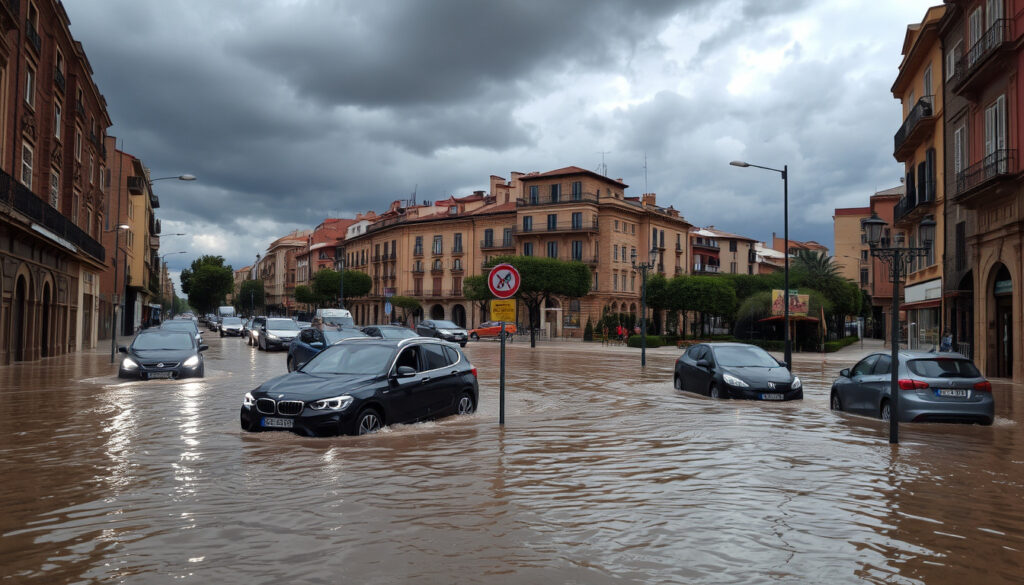
- Valencia, Andalusia, and Catalonia have seen the worst flooding in recent years (Express).
- The October 2024 Valencia floods were captured by ESA satellites, showing the scale of inundation.
- Urban areas along the Mediterranean coast are particularly vulnerable because of impermeable surfaces and outdated drainage.
What caused the recent flooding?
- Most floods are linked to DANA (depresión aislada en niveles altos) – a cut-off low-pressure system that stalls and dumps heavy rain (AEMET).
- Climate change is making DANA events more intense, as warmer air holds more moisture.
- Greenpeace noted in 2023 that “droughts, heatwaves and torrential rain events (responsible for floods) seem to be increasing in frequency and intensity” (Greenpeace).
DANA is Spain’s flash-flood engine. For travelers, the key takeaway: avoid low-lying areas when orange or red rain alerts are active, even if the sky looks clear overhead.
The implication: Flooding is not a one-off tragedy – it’s a recurring hazard that is intensifying. The regions most at risk are also the most visited, which means tourist infrastructure is on the front line.
What are the biggest risks for tourists in Spain?
Extreme weather hazards
- Flooding, heatwaves, and wildfires are the three main threats (UK Foreign Travel Advice (official government guidance)).
- Heatwaves can push temperatures above 45°C, especially in Andalusia and the interior.
- Wildfire season runs June–September, with rural and forested areas under highest risk.
Health risks and travel safety
- Heatstroke, dehydration, and waterborne diseases after flooding are real concerns (French Ministry for Europe and Foreign Affairs).
- The US Embassy in Spain warned U.S. citizens about extreme heat covering all regions except the Canary Islands in June 2026 (US Embassy in Spain).
- Travelers are advised to monitor AEMET alerts and the Civil Protection app for real-time updates.
Spain remains open for tourism, but the risk profile is shifting. The savvy traveler now checks weather alerts with the same diligence as flight times.
What this means: The biggest risk isn’t one specific event – it’s the unpredictability. Staying informed through official channels is the single best protection.
Why is Spain on level 4 alert?
What does Level 4 alert mean?
- Level 4 is the highest alert on AEMET’s scale, indicating extreme risk and the need for immediate action (Wego (travel blog, summarizing AEMET scale)).
- It is triggered by extreme weather events such as torrential rain, severe floods, or heatwaves that pose a direct threat to life.
- When Level 4 is declared, authorities may close roads, suspend public transport, and order evacuations.
Which areas are affected?
- In October 2024, Level 4 alerts were issued for Valencia, Murcia, and Andalusia due to catastrophic flooding.
- During the June 2026 heatwave, red alerts (equivalent to Level 4) were in effect for Andalucía, Cantabria, and the Basque Country (US Embassy in Spain).
- AEMET manages the alert system at the province and autonomous-community level (AEMET).
The catch: Level 4 alerts are rare but becoming more frequent. When they appear, they are not suggestions – they are legally enforced safety measures.
Was Valencia airport affected by the floods?
How did the flooding impact flights?
- Valencia Airport flooded in October 2024, leading to the disruption of nearly 80 flights (Express).
- The airport was temporarily closed for safety inspections, causing delays and cancellations.
- Passengers were advised to contact their airlines and avoid traveling to the airport until further notice.
What was the airport’s response?
- Airport staff activated emergency protocols, including pumping water from runways and terminals.
- Civil Protection and AEMET coordinated with airport authorities to manage the situation.
- Normal operations resumed after inspections confirmed structural safety.
Why this matters: Valencia is a major gateway for tourists. An airport shutdown during peak season can cascade into travel chaos. Knowing the alert status before you fly is critical.
What are the biggest problems in Spain right now?
Extreme weather as a major issue
- Floods, droughts, heatwaves, and wildfires are the top environmental concerns (Greenpeace).
- Climate change is amplifying each of these events, making them more frequent and severe.
- Infrastructure – roads, railways, water systems – is under pressure, especially in coastal and southern regions.
Long-term climate risks
- Spain’s agriculture sector is threatened by persistent drought and heatwaves.
- Water scarcity is a growing concern in the south and the Mediterranean coast.
- By 2050, an estimated 35–45% of properties could be at risk from extreme weather, according to Climatig data cited in the Greenpeace report.
Spain’s climate is not just warming – it is becoming more volatile. The country that draws 85 million tourists a year must rethink how it builds, how it farms, and how it warns people.
The pattern: The biggest problems are interconnected. A drought increases wildfire risk; a heatwave dries the soil, making flash floods worse. Spain is experiencing the full chain reaction.
Timeline signal
- October 2024 – Torrential rains cause devastating floods in Valencia, witnessed by ESA satellites. Valencia Airport floods, disrupting nearly 80 flights.
- 2023 – Greenpeace report highlights increasing frequency of droughts, heatwaves, and torrential rain in Spain.
- March 2026 – AEMET issues orange wind warnings for 11 regions (Euro Weekly News).
- June 2026 – US Embassy warns of extreme heat covering all of mainland Spain, with red alerts for three regions.
Confirmed facts
- Floods occurred in Valencia, Andalusia, and Catalonia in October 2024.
- Valencia Airport experienced flooding and flight disruptions.
- Red alerts were in effect for Andalucía, Cantabria, and Basque Country in June 2026.
What’s unclear
- Exact percentage of property risk by 2050 (models vary by source).
- Direct attribution of specific events to climate change at the exact percentile.
- Long-term economic impact on tourism infrastructure.
- AEMET issued Level 4 alerts for several regions in 2024 and 2026 (specific conditions vary).
- Civil Protection app provides real-time alerts for multiple hazards (coverage tested only in limited zones).
Expert perspectives
“Europe is not immune to extreme weather events.”
– Imperial College London report (climate research)
“Droughts, heatwaves and torrential rain events (responsible for floods) seem to be increasing in frequency and intensity.”
– Greenpeace (2023 report)
“35–45% Properties at risk of extreme weather events by 2050.”
– Climatig (data analysis on natural and climate risks in Spain)
The forward stake is clear: Spain’s weather extremes are not a passing season. For the millions of tourists each year, the choice is straightforward: stay informed through official alerts, or risk getting caught in a crisis. For the Spanish government, the challenge is even bigger – build resilience now, or watch the costs compound.
Related reading: Check AEMET’s official weather warnings for Spain · UK government travel advice for Spain – safety and security
For a detailed breakdown of current alerts and evacuation procedures, see our guide on travel safety during red warnings.
Frequently asked questions
How can travelers prepare for extreme weather in Spain?
Check AEMET alerts daily, download the Civil Protection app, and pack a small emergency kit with water, snacks, and a power bank. Avoid traveling during red alerts.
What is a DANA event and why does it cause floods?
DANA stands for “depresión aislada en niveles altos” – a cut-off low-pressure system that can stall over a region, dumping heavy rain in a short time. It’s the main cause of flash floods in Spain.
Are Spanish airports often affected by flooding?
Valencia Airport’s flooding in 2024 was a rare event, but other airports near the coast could face similar risks during extreme rain. AEMET alerts are a good predictor.
Which regions in Spain are safest from extreme weather?
The northern coast (Galicia, Asturias, the Basque Country) generally has milder temperatures and lower flood risk, though no region is entirely safe. The Canary Islands avoided the June 2026 heatwave.
Does Spain have a national alert system for weather?
Yes – AEMET issues color-coded alerts (yellow, orange, red) at the province level. The Civil Protection app aggregates all active alerts.
What should I do if I encounter a flood while traveling in Spain?
Move to higher ground immediately, avoid walking or driving through floodwater, and follow instructions from local authorities. Contact your embassy for assistance.
Are there any travel insurance requirements for Spain related to weather?
Travel insurance is strongly recommended. Check that your policy covers trip cancellations due to extreme weather and natural disasters.
More related posts
 Love Holidays Discount Code: How to Save with Verified Deals
 Who Killed Charlie Kirk? Assassination Facts and Updates
 Boylesports Roulette Results Today Live – How to Access Results
 Connacht vs Munster Tickets 2027: Prices & How to Buy
 Latest News Today Ireland: M9 Crash, 4 Dead, Garda Investigation
 Kelly and Dollard Waterford: Reviews, Hours, Appliances
 Dacre Montgomery Movies and TV Shows: Complete Guide
 Live Sports on TV Today: Full Schedule & Channels (2025)
