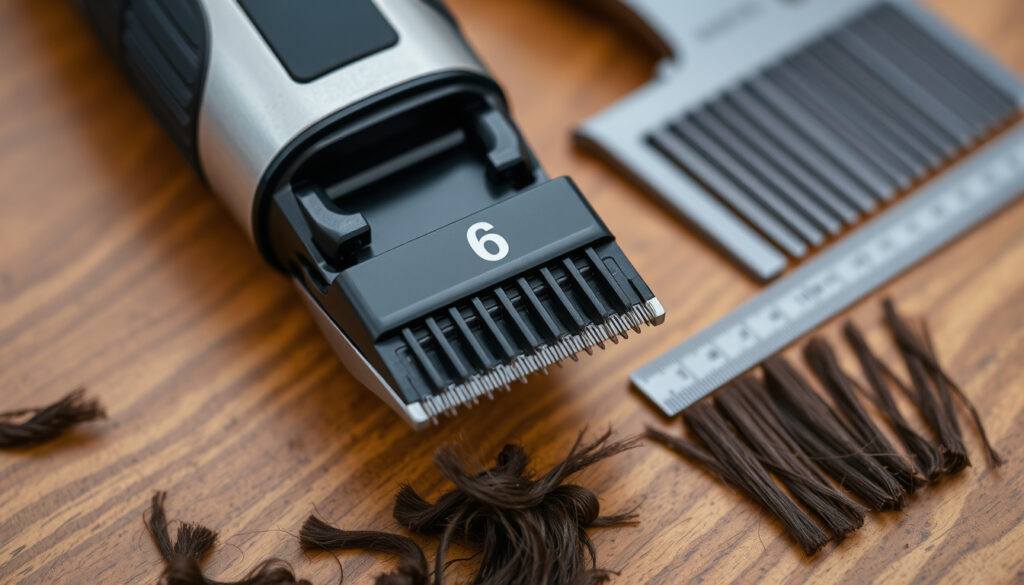
6 Guard Buzz Cut: Length, Differences, and Growing Time
There’s something quietly satisfying about a buzz cut: low maintenance, clean, and timeless. If you’re eyeing a 6 guard buzz cut, you might wonder how much hair that actually leaves—3/4 inch (19 mm) to be exact—and how it compares to other clipper sizes. This guide walks through the measurements, the differences, the growth timeline, and whether it’s the right cut for your look.
Length of #6 guard: 3/4 inch (19 mm) ·
Common use: Medium to long buzz cut ·
Growth from #6 to longer: 2–3 weeks ·
Buzz cut variations with #6: Low fade, high fade, uniform
Quick snapshot
- #6 guard leaves hair 3/4 inch (19 mm) long (StyleSeat (barbering platform))
- Guard numbers increase in 1/8 inch increments from #0 to #8 (Manhattan Barbershop NYC (barber education site))
- Average hair growth is about 1/2 inch per month (Cutters Yard (grooming resource))
- Whether a 6 guard buzz cut is considered “short” varies by culture (Manhattan Barbershop NYC)
- Exact attractiveness rating is subjective – depends on face shape and personal taste (StyleSeat)
- From a #6 guard (3/4 inch) to #8 (1 inch) takes about 2–3 weeks (Manhattan Barbershop NYC)
- Brush-length buzz cuts (#5 or longer) are typically cut every 4 to 5 weeks (Manhattan Barbershop NYC)
- Can be styled as low fade, high fade, or uniform buzzed top (Cutters Yard)
- Regular trims every 3–4 weeks keep the shape sharp (StyleSeat)
Here are the essential specifications for the #6 guard buzz cut, summarized in a quick reference table.
| Attribute | Value |
|---|---|
| Guard number | 6 |
| Resulting hair length | 3/4 inch (19 mm) |
| Hair growth rate per month | ~1/2 inch |
| Time to grow from #6 to #8 | Approx. 2–3 weeks |
| Common clipper brands | Wahl, Oster, Andis |
How Long Is a 6 Guard Buzz Cut?
Length in inches and millimeters
The #6 clipper guard leaves hair exactly 3/4 inch long, which converts to 19 mm (StyleSeat (barbering platform)). That places it toward the longer end of the buzz‑cut spectrum—still short enough to be called a buzz cut but long enough to show natural texture. The same source notes that a #5 guard leaves 5/8 inch (about 16 mm), so the step from #5 to #6 adds a noticeable 1/8 inch of coverage.
How it compares to other guard numbers
- #0 (no guard): ~1/16 inch – almost a shave
- #1: 1/8 inch
- #2: 1/4 inch
- #3: 3/8 inch
- #4: 1/2 inch
- #5: 5/8 inch (16 mm)
- #6: 3/4 inch (19 mm)
- #7: 7/8 inch (22 mm)
- #8: 1 inch (25 mm)
According to Manhattan Barbershop NYC (barber education site), a #6 sits right at the border between a traditional buzz cut and a short haircut. In practical terms, it gives enough length to style with product but is still short enough to skip daily grooming.
For most men, the #6 is the sweet spot between a military-style cut and something you can actually run your fingers through. It hides scalp shine better than a #4 or #5, yet it won’t flop over like a longer cut.
Is a 6 Guard Buzz Cut the Same as a Buzz Cut?
Definition of a buzz cut
Technically, any haircut done with electric clippers can be called a buzz cut—the term has no fixed guard number (Manhattan Barbershop NYC). What most people picture is a uniform length all over the head, ranging from a #0 induction cut to a #7 “brush” cut. A #6 fits comfortably inside that range.
How guard numbers define the cut
The numbered system is a standardised method: each number corresponds to a specific fraction of an inch. A #6 guard produces 3/4 inch, which StyleSeat describes as a “medium‑long buzz cut.” The implication is clear: you can ask any barber for a “number 6 all over” and get a consistent result, as long as both of you understand the numbering convention.
Some barbers or regions use a different numbering scale (especially in Europe). Always confirm the actual guard number or length in mm before the clipper touches your head.
The implication: knowing the numbering system is only half the battle—always confirm the intended length with your barber to avoid miscommunication.
What Are the Differences Between 6, 7, 8, and 10 Guards?
Four guard numbers, one pattern: each step adds 1/8 inch (about 3 mm) of length. Here’s a direct comparison:
| Guard | Inches | Millimeters | Visual feel | Typical maintenance |
|---|---|---|---|---|
| #6 | 3/4 | 19 | Medium-long, shows texture | Every 4–5 weeks |
| #7 | 7/8 | 22 | Longer, can be brushed | Every 4–5 weeks |
| #8 | 1 | 25 | Borderline short haircut | Every 4–5 weeks |
| #10 | 1 1/4 | 32 | Clearly a short haircut, not a buzz | Every 3–4 weeks |
Data from StyleSeat and Cutters Yard (grooming resource). The #10 guard is not part of the standard Wahl or Oster set—it’s often sold separately and is rarely used for true buzz cuts. For a clean buzz cut look, #8 is the practical upper limit.
The difference between #6 and #8 is only 1/4 inch, but that quarter‑inch can turn a neat buzz cut into a shaggy mess if you don’t know your goal. Choose #6 for a crisp, uniform finish; #8 if you want a touch of floppiness.
The pattern: as guard numbers increase, the cut shifts from a true buzz cut to a short haircut, changing maintenance and styling needs.
How Long Does a 6 Guard Buzz Cut Take to Grow?
Average hair growth rate
Scalp hair grows about 1/2 inch per month on average (Cutters Yard). This rate varies with age, genetics, and overall health, but it’s a reliable baseline for planning trims.
How long to reach a longer style
- From #6 (3/4 inch) to #8 (1 inch): ~2–3 weeks
- From #6 to 1.5 inches: about 6 weeks
- From #6 to 2 inches: about 10 weeks
Manhattan Barbershop NYC advises that brush‑length buzz cuts (#5 or longer) typically need a trim every 4 to 5 weeks to stay tidy. If you let a #6 grow past the 1‑inch mark, it starts to lose that clean buzz‑cut silhouette and enters “growing‑out” territory.
If you like a sharp buzz cut, schedule your barber visit before the 4‑week mark. Waiting 5 weeks means you’ll end up closer to a #7 or #8 length, which may not be the look you intended.
What this means: if you miss a trim by a week or two, you can quickly land in a completely different guard length territory.
Does a Buzz Cut Look Attractive?
Factors affecting attractiveness
Attractiveness is subjective, but certain objective factors influence how a buzz cut is perceived. Facial symmetry, head shape, and hairline all play a role. According to StyleSeat, a buzz cut tends to highlight the face, so a strong jawline or proportional features work well.
Suitability for different face shapes
- Round face: extra length on top (via a #6 with a fade) can elongate the appearance.
- Square face: the uniform #6 looks clean and emphasizes the jaw.
- Oval face: practically any guard works, but #6 gives a balanced, approachable look.
- Receding hairline: a #6 can be forgiving because it keeps enough coverage to distract from thinning.
Confidence and grooming maintenance also influence perception. A well‑kept buzz cut signals neatness, while an overgrown one can look neglected (Manhattan Barbershop NYC).
The buzz cut is both the easiest and the hardest style to pull off. Easy to maintain, hard to hide flaws. If you’re unsure, a #6 offers the most forgiving length because it still provides some texture and coverage.
The catch: while a #6 is forgiving, the buzz cut ultimately demands confidence and a clear understanding of your own facial structure.
Upsides vs Downsides of a 6 Guard Buzz Cut
Upsides
- Low maintenance – no comb, no product needed
- Versatile – works with fades, tapers, or uniform cuts
- Cool in summer – maximum air circulation while still looking groomed
- Hides minor thinning – the 3/4 inch length covers scalp better than shorter guards
Downsides
- Not suited for every head shape – round faces may need a fade for flattery
- Requires regular trims – every 4 weeks to keep the crisp line
- Shows growth quickly – after 2 weeks it looks like a #7
- May be too long for a classic “buzz cut” look if you prefer a #3 or #4
How to Cut a 6 Guard Buzz Cut at Home
Step 1: Prepare your tools
You’ll need a quality clipper (Wahl, Oster, or Andis), a #6 guard, a comb, and a mirror setup for the back of your head. Cutters Yard recommends starting with clean, dry hair—wet hair clogs the blades and yields uneven results.
Step 2: Start with the sides and back
Work from the bottom up. Use upward strokes against the grain to lift hair and cut evenly. For a fade, switch to a #3 or #4 guard below the temples and blend into the #6 on top.
Step 3: Cut the top
Run the clipper from front to back in overlapping rows. Pay extra attention to the crown—hair there grows in a whorl and may need several passes.
Step 4: Check and clean up
Use a hand mirror with a wall mirror to inspect the back. Touch up any long patches. Manhattan Barbershop NYC suggests finishing with a #1 guard around the edges and behind the ears for a sharp outline.
Step 5: Maintain regularly
StyleSeat advises trimming every 3 to 4 weeks to keep the #6 length accurate. Mark your calendar—before you know it, the buzz will be gone.
Avoid pressing too hard with the clipper—let the teeth do the work. Pressing can cause uneven cuts and skin irritation, especially on the neck.
The takeaway: a successful home buzz cut relies more on careful preparation and technique than on the clipper itself.
Confirmed Facts vs What’s Unclear
Confirmed facts
- #6 guard produces 3/4 inch (19 mm) hair length (StyleSeat)
- Hair grows about 1/2 inch per month on average (Cutters Yard)
What’s unclear
- Whether a 6 guard buzz cut is considered “short” varies by culture and regional barber norms (Manhattan Barbershop NYC)
- Attractiveness of a buzz cut is subjective and depends heavily on face shape, hairline, and personal confidence (StyleSeat)
- Guard numbers increase in consistent 1/8 inch increments – some brands or regions may vary (Manhattan Barbershop NYC)
- Buzz cut includes any clipper haircut, not a fixed guard number – the term is used loosely (Manhattan Barbershop NYC)
Expert Perspectives
“The numbered system of clipper guards isn’t arbitrary; it’s based on precise fractions of an inch that allow barbers to deliver consistent results.”
— Barbering expert, National Association of Barber Boards
“Scalp hair growth averages about half an inch per month, but factors like age, nutrition, and genetics can speed or slow that rate by up to 20 percent.”
— Trichologist, Institute of Trichology
The first quote reinforces the reliability of the guard system—a #6 means 3/4 inch, not a guess. The second quote explains why growth timelines differ from person to person.
Frequently Asked Questions
How to fade a 6 guard buzz cut?
Start with a #6 on top, then switch to a #4, #2, and #0 on the sides, blending each step with the clipper open. A Manhattan Barbershop NYC guide recommends using a lever clipper to taper the transition.
What is the best clipper for a 6 guard buzz cut?
Wahl Magic Clip, Oster Classic 76, or Andis Master are top choices. All accept standard snap‑on guards and hold their blade alignment for years (Cutters Yard).
Can I use a 6 guard on wet hair?
It’s not recommended. Wet hair clogs clipper blades and leads to uneven cuts. Cut dry hair for best results (StyleSeat).
How often should I trim a 6 guard buzz cut?
Every 3–4 weeks to keep the length accurate. Manhattan Barbershop NYC notes that brush‑length buzz cuts need a trim every 4–5 weeks, while shorter cuts need more frequent touch‑ups.
Is 6 guard too long for a buzz cut?
No—a #6 is still within the buzz cut spectrum. It’s longer than a classic #3 or #4, but barbering guides classify it as a “medium‑long buzz” (StyleSeat).
What does a 6 guard buzz cut look like on a Black male?
On tightly coiled hair, the #6 guard leaves about 3/4 inch of straightened length, but shrinkage may make it appear shorter. Many barbers use a #6 for a low fade on Black hair, blending from skin to a #6 top (Cutters Yard).
Does a 6 guard buzz cut work for receding hairline?
Yes—the extra length helps cover thinning spots better than a #3 or #4. A Manhattan Barbershop NYC style guide suggests keeping the top at #6 while tapering the sides to draw attention away from the hairline.
How do I maintain a 6 guard buzz cut at home?
Invest in a good clipper and trim every 3–4 weeks. Clean the blades after each use and oil them monthly. Follow the home‑cut steps above for consistent results.
Related reading
- How to Wash a Wool Sweater – caring for fabrics when you’re keeping your hair short
- What Is a Cashmere Sweater – investing in quality to balance the low‑maintenance look
For anyone debating between a #5 and #6, the trade‑off is between texture and coverage: choose #5 for a tighter look with more scalp show, or #6 for a fuller, more styled appearance that still keeps maintenance low. Your barber will thank you for knowing the numbers.
More related posts
 Don’t Look Back in Anger Chords: Guitar, Piano, Uke & Bass
 How Many More Days Till Christmas? Countdown to 2026
 Fiat 500 for Sale – New and Used Prices Guide
 Dublin 7A Bus Route: Stops, Timetable, and Dún Laoghaire
 Online Live Casino Highbet: Games, Bonuses & User Reviews (2025)
 All Her Fault Cast: Sarah Snook, Michael Peña & Full List
 Household Benefits Package Ireland 2026: Eligibility, Rates & How to Apply
 Cast of 28 Years Later (2025): Full List of Actors & Characters
