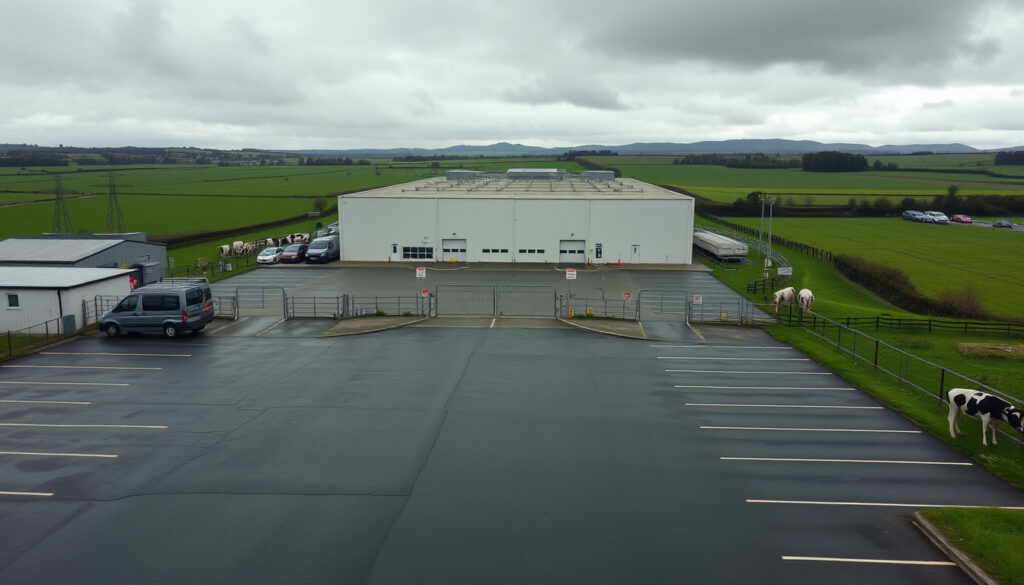
Leprino Foods Company Laois Factory Closure: Causes & Impact
When a state-of-the-art mozzarella plant that opened just six years ago with €130 million in investment suddenly announces its closure, the question is not whether something went wrong, but how Brexit and global dairy oversupply made a flagship Irish factory unviable. Leprino Foods’ decision to shut down its Portlaoise factory, affecting 130 jobs, is a story of post-Brexit trade barriers, global dairy oversupply, and a strategic shift in production.
Jobs lost: 130 ·
Investment (€): 130 million ·
Announcement date: 19 August 2025 ·
Expected closure: Second half 2026 ·
Year plant opened: 2019
Quick snapshot
- Leprino Foods to close Portlaoise plant (The Irish Times)
- Announced 19 August 2025 (The Irish Times)
- Closure expected in H2 2026 (The Irish Times)
- 130 direct jobs lost (The Irish Times)
- Significant indirect effects in Midlands (The Irish Times)
- SIPTU calls for government taskforce (The Irish Times)
- Brexit trade barriers
- Global dairy oversupply
- Operational costs of €130m plant
- IDA criticised by local politicians
- Union describes closure as ‘shocking’
- No further comment from Leprino Foods
Nine key facts about the Leprino Foods Portlaoise plant tell the story at a glance.
| Label | Value |
|---|---|
| Company | Leprino Foods Company |
| Location | Portlaoise, County Laois, Ireland |
| Jobs affected | 130 |
| Investment | €130 million |
| Announcement date | 19 August 2025 |
| Expected closure | Second half of 2026 |
| Year plant opened | 2019 |
| Primary product | Mozzarella cheese |
| Target market | UK and EU |
Why is Leprino Foods closing its Portlaoise factory?
Brexit trade disruptions and tariffs
- The closure announcement was made on 19 August 2025, with Leprino citing “market conditions and Brexit” as key factors (The Irish Times).
- Brexit created significant barriers for exporting mozzarella to the UK, the plant’s primary market, including new customs checks and tariffs.
Global dairy market oversupply
- The global dairy market has been facing oversupply, putting pressure on margins for cheese producers across Europe.
- Leprino said the decision was necessary because “the level of sustainable improvement needed could not be achieved at the site” (The Irish Times).
Operational challenges at the €130m plant
- Despite the state-of-the-art facility, the plant struggled with cost competitiveness, partly due to its location in a high-cost environment.
- Production from Portlaoise is to be transferred to existing Leprino facilities in Magheralin, Northern Ireland, and Llangefni, Wales (The Irish Times).
Leprino is not leaving Europe — it’s optimising its footprint post-Brexit by consolidating production inside the UK, while shuttering the Irish site that relied on UK-bound exports.
The implication: No single factor caused the closure; Brexit friction, global oversupply, and the plant’s own cost structure converged to make the Portlaoise site unsustainable.
“Leprino said the closure followed a comprehensive evaluation of options to improve the financial and operational performance of the Portlaoise site.”
— The Irish Times (leading Irish daily)
How many jobs will be lost and what is the impact on Laois?
130 direct job losses
- 130 workers at the Portlaoise plant will lose their jobs (Midlands 103).
- Leprino said it would offer enhanced redundancy packages and career transition assistance to workers (Farmers Journal).
Indirect employment effects in the Midlands
- The plant was described as a significant employer in the Portlaoise and midlands area (The Irish Times).
- Local supply chains, including transport and services, are expected to suffer knock-on effects.
Reaction from union SIPTU
- SIPTU described the closure as “shocking and regrettable” and called for a government taskforce to support affected workers (Midlands 103).
For a small county like Laois, losing 130 well-paying industrial jobs is a heavy blow, especially when the plant was seen as a flagship investment.
What this means: With a year of notice and redundancy packages, the immediate shock is cushioned, but the long-term hole in the Midlands labour market will need new investment to fill.
When did the Leprino Foods Portlaoise plant open and what was its history?
Opening in 2019 with €130m investment
- The Portlaoise plant opened in 2019 (some sources say 2020) as a joint venture between Leprino Foods and Glanbia (Farmers Journal).
- It was built with a €130 million investment, designed to produce mozzarella for the UK and EU markets.
Glanbia partnership and initial operations
- The facility was originally a partnership with Glanbia, but Leprino later took full control.
- The plant was located at J17 National Enterprise Park in Portlaoise (Leinster Express).
Production ramp-up and challenges
- The site had capacity to produce around 45,000 tonnes of cheese per year, according to local reports (Leinster Express).
- Despite the investment, the plant faced ongoing operational challenges, including Brexit-related disruptions from 2020 onward.
A €130m plant built with the latest technology could not overcome the fundamental shift in trade routes caused by Brexit.
The pattern: The plant’s short operating life — barely six years from opening to closure announcement — reveals how quickly Brexit rewrote the economics of Irish food manufacturing for the UK market.
What role did Brexit play in the Leprino Foods Portlaoise closure?
Brexit trade barriers and new customs checks
- Brexit created significant export hurdles for the Portlaoise plant, as its primary market was the UK.
- New customs checks, tariffs, and supply chain friction made it harder to compete with UK-based producers.
Shift in supply chains for Irish dairy
- The Irish dairy sector has been restructuring post-Brexit, with many companies moving production inside the UK to avoid trade barriers.
- Leprino’s decision to transfer production to Magheralin (NI) and Llangefni (Wales) is a direct example of this shift (The Irish Times).
Comparison with other Irish food exporters
- Many Irish food companies have faced similar pressures, though few have shut down a plant as new as Portlaoise.
- The closure highlights the specific vulnerability of companies that built capacity for the UK market before the 2016 referendum.
Brexit didn’t just add paperwork — it fundamentally changed the economics of running an Irish plant for a UK market, making it cheaper to produce inside the UK.
The implication: Every Irish food exporter with heavy UK market exposure now faces a similar calculus — produce inside the UK or lose margin to trade friction.
What are the reactions from local politicians, unions, and the IDA?
IDA branded ‘useless’ by local representatives
- Local politicians in Laois-Offaly criticised the IDA for not preventing the closure, branding the agency “useless”.
- The IDA said it was disappointed but noted that commercial decisions are outside its control.
SIPTU calls for government intervention
- SIPTU called for a taskforce to support affected workers and explore alternative uses for the site (Midlands 103).
- The union described the closure as “shocking and regrettable” and urged the government to step in.
Lack of official statement from Leprino Foods
- Beyond the initial announcement, Leprino Foods has not issued further public statements.
- The company said it would continue to explore opportunities for the site with potentially interested third parties (Farmers Journal).
“SIPTU described the closure as shocking and regrettable and called for a government taskforce.”
— Midlands 103 (local radio station)
“Local politicians branded the IDA ‘useless’ for failing to retain the plant.”
The catch: Political anger is aimed at the IDA, but the company’s commercial logic — moving production inside the UK — is a pattern no Irish agency can reverse.
Timeline: Key events in the Leprino Foods Portlaoise story
- 2019 – Leprino Foods Portlaoise plant opens with €130m investment (Farmers Journal)
- 2020–2024 – Plant operates, faces Brexit-related trade disruptions
- 19 August 2025 – Leprino Foods announces closure of Portlaoise plant (The Irish Times)
- Second half 2026 – Expected final closure and job losses
The timeline means workers have roughly a year of notice, but the uncertainty about the site’s future and indirect job losses will persist until 2026.
The pattern: A year-long wind-down gives time for transition but also prolongs uncertainty for suppliers and the wider Laois economy.
Confirmed facts and what’s still unclear
Confirmed facts
- Closure announcement on 19 August 2025 (The Irish Times)
- 130 job losses (The Irish Times)
- Closure scheduled for H2 2026
- Brexit cited as a factor
What’s unclear
- Exact closure date within 2026
- Whether the site will be sold or repurposed
- Severity of indirect job losses
- Full financial details of plant operations
Summary: What the Leprino Foods closure means for Laois and beyond
The Portlaoise factory closure is a concrete consequence of Brexit’s long-term impact on Irish food manufacturing. For the 130 workers, the immediate future is uncertain, but the company’s offer of redundancy packages and career transition assistance provides some buffer. For the wider Laois economy, the loss of a flagship employer signals a need for new investment. The implication for other Irish dairy exporters is clear: production for the UK market is now better done inside the UK, and the Portlaoise site may be a harbinger of further consolidation.
thecurrency.news, leinsterexpress.ie, midlands103.com, linkedin.com, careers.leprino.com
Frequently asked questions
What will happen to the Portlaoise site after the closure?
Leprino said it would continue to explore opportunities for the site with potentially interested third parties, but no specific plans have been announced.
Are there any alternatives for the 130 employees?
Leprino is offering enhanced redundancy packages and career transition assistance. SIPTU has called for a government taskforce to support workers.
What was the production capacity of the Leprino Foods Portlaoise plant?
Local reports indicated the site had capacity to produce around 45,000 tonnes of cheese per year.
Did the plant receive any government grants or incentives?
Details of specific grants have not been disclosed, but the plant was built with €130 million investment and was a joint venture with Glanbia initially.
How does this closure compare to other food factory closures in Ireland?
This closure is notable because the plant was relatively new and well-funded. Other closures in the sector have been linked to Brexit and global dairy market pressures.
Will Leprino Foods continue operations in other parts of Ireland?
No, the Portlaoise closure is the only Irish facility. Production is moving to existing sites in Northern Ireland and Wales.
What impact will the closure have on the Irish cheese export market?
The Portlaoise plant produced mozzarella primarily for the UK market. The closure will reduce Irish cheese exports to the UK, but other producers may fill the gap.
Related reading
- M&S Liffey Valley: Opening Hours, Store Info & Ireland Closures – Another Irish business closure story.
- Dunnes Stores Dun Laoghaire: Hours, Closure, Salaries & More – Context on retail closures in Ireland.
More related posts
 The Iron Claw Cast Guide: Von Erich Brothers & True Story
 What Is a CRC Error? Causes, Fixes, and Prevention
 Hope and Ivy Dresses: Where to Buy, Sizing, and Brand Review
 Smyths Toys for Girls: Best Gifts & Popular Toys for Every Age
 Boylesports Roulette Results Today Live – How to Access Results
 Businesses for Sale Ireland: 2026 Guide to Profitable Opportunities
 100 Dollar to Euro: Live Exchange Rate Converter & Rates
 Dunnes Stores Midi Dress 2025: Prices, Colors & Occasions
