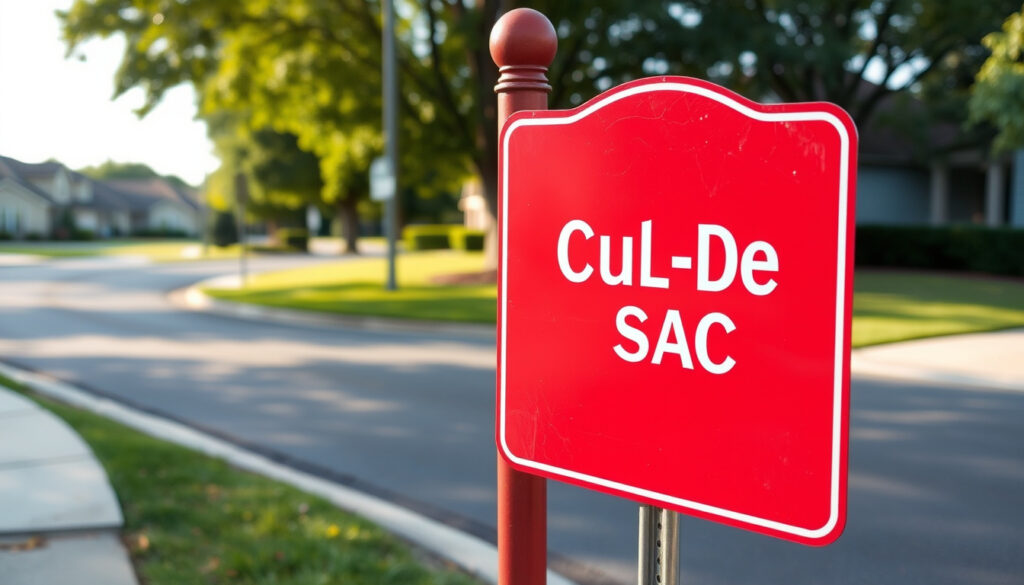
Cul de Sac Sign: Meaning, Types & Driving Tips
Driving down an unfamiliar street and spotting a sign that shows a road ending in a block—that’s the cul-de-sac sign, and it’s telling you something important. In Ireland it’s officially called the F 350 sign, and understanding what it means can save you from awkward three-point turns in a dead end.
Cul-de-sac sign used in: over 30 countries · Regulatory code (Ireland): F 350 · Literal translation from French: bottom of the sack · Common alternative name (UK): dead-end street · Safety sign categories (global): 4 (mandatory, prohibition, warning, emergency)
Quick snapshot
- Literally “bottom of the sack” in French (Teoricentralen (driving theory glossary))
- Irish sign code F 350 (Traffic Signs Manual Chapter 4 – Ireland’s official road sign guidance)
- Indicates a road with no through route (National Driving School (Irish driving-test resource))
- Exact date of first cul-de-sac traffic sign in Ireland is not well documented (Highway Safety Developments (Irish road sign supplier))
- Minor design variations between local authorities may occur (Highway Safety Developments (Irish road sign supplier))
- 18th century – cul-de-sac enters English from French (Wikipedia (road sign overview))
- 20th century – standardised road sign systems include dead-end signs (Wikipedia (road sign overview))
- Current – F 350 in use across Ireland; UK uses similar design (Wikipedia (road sign overview))
- When you see a cul-de-sac sign, prepare to turn around or reverse out (National Driving School (Irish driving-test resource))
- Know the sign for your driving theory test – it appears on Irish theory exams (National Driving School (Irish driving-test resource))
Six key facts about the cul-de-sac sign, drawn from official Irish traffic manuals and international driving resources:Traffic Signs Manual Chapter 4 (Ireland’s official design specifications)
| Fact | Detail |
|---|---|
| Official sign code (Ireland) | F 350 |
| Literal French meaning | bottom of the sack |
| Alternative term (UK) | dead-end street |
| Year entered English | 18th century (approx. 1730s) |
| Number of safety sign types | 4 (mandatory, prohibition, warning, emergency) |
| Common test question on | theory-tester.com and driving tests |
What does a cul-de-sac sign mean?
Literal translation and origin
- The phrase “cul-de-sac” comes from French and literally translates to “bottom of the sack” (Teoricentralen (driving theory glossary)).
- It entered the English language in the 18th century as a metaphor for a dead-end street.
Regulatory meaning on the road
- In Ireland, the cul-de-sac sign is coded F 350 and falls under the informational sign category (Traffic Signs Manual Chapter 4 – Other Information Signs (Ireland’s official road sign guidance)).
- The sign tells drivers that the road ahead has no through route and they will need to turn around.
How drivers should respond
- When you see a cul-de-sac sign, anticipate limited maneuvering space and plan your entry and exit carefully (National Driving School (Irish driving-test resource)).
- Check your mirrors and be prepared to reverse or perform a U-turn at the end of the street.
Learner drivers in Ireland often miss this sign during their test. Knowing the F 350 symbol—and what it implies about road layout—can be the difference between a pass and a penalty.
The implication: Recognizing the cul-de-sac sign early is a practical test skill that directly affects driving safety in residential areas.
What does cul-de-sac literally mean?
French origin: “bottom of the sack”
- The term is composed of “cul” (bottom) and “sac” (sack), literally “bottom of the sack” (Teoricentralen (driving theory glossary)).
- It describes a street that ends in a dead end, much like a sack’s closed bottom.
Historical use in English
- First recorded in English in the early 18th century, adopted directly from French urban planning terminology.
Common misconceptions
- Some assume it means “hole in the sack” – the correct translation is “bottom of the sack.”
- It is not a warning sign but an informational sign, as classified in the Irish traffic sign system (Spin Driving School PDF (Irish road sign reference)).
The catch: Misunderstanding the literal meaning can lead to confusion about the sign’s purpose—it informs, not warns.
What do British people call a cul-de-sac?
Dead-end street
- In the UK and Ireland, “cul-de-sac” and “dead-end street” are used interchangeably (Teoricentralen (driving theory glossary)).
- “Dead end” is the more informal term; official signs may use either phrase.
Cul-de-sac vs. close
- In some parts of the UK, a cul-de-sac may be referred to as a “close” particularly on street name signs.
- Driving tests in both Ireland and the UK expect you to recognize the symbol, not just the word.
Usage in road signs in the UK and Ireland
- Both countries use a rectangular sign with the dead-end symbol and the words “cul-de-sac” or “dead end”. Ireland uses the code F 350 (Traffic Signs Manual – Chapter 4 Other Information Signs (Ireland’s official road sign guidance)).
- The meaning is identical: the road has no through passage.
What this means: Regional name variations do not change the driving response—always prepare for a dead end.
What are the four types of signs?
Mandatory signs
- Blue circles with white symbols – tell drivers what they must do (e.g., “turn left ahead”).
Prohibition signs
- Red circles with black symbols – tell drivers what they must not do (e.g., “no entry”).
Warning signs
- Yellow triangles with black symbols – alert drivers to hazards ahead.
Emergency or safe condition signs
- Green squares or rectangles – indicate emergency exits, first aid, or safe routes.
This classification applies to both workplace safety and road signage worldwide (Beaverswood (health and safety sign manufacturer)). The cul-de-sac sign, under Irish rules, belongs to the informational family – a fifth category often grouped with destination signs (Traffic Signs Manual – Chapter 4 Other Information Signs (Ireland’s official road sign guidance)).
Many drivers confuse the four safety sign types with the separate category of informational signs like F 350. Knowing the difference is crucial for the Irish theory test – and for staying safe when you actually drive into a dead end.
The pattern: Safety sign categories are universal, but informational signs like cul-de-sac sit outside that framework — a distinction that matters on the test.
How do you indicate in a cul-de-sac and perform a U-turn?
Approaching the end of a cul-de-sac
- Slow down early and check for pedestrians, especially children playing, in residential cul-de-sacs (National Driving School (Irish driving-test resource)).
Indicating and turning safely
- Signal right to indicate you intend to turn around at the head of the cul-de-sac.
- Use the turning circle or carriageway end – reverse only if there is no turning head.
Using the turning circle or head of the cul-de-sac
- Position your car to the right side of the road to perform a smooth U-turn.
- Check all mirrors and blind spots before and during the turn.
The implication: In Irish driving tests, failing to signal properly or misjudging the space in a cul-de-sac is a common fault. Practice beforehand to build confidence.
Confirmed facts
- Cul-de-sac literally means “bottom of the sack” (Teoricentralen)
- Irish sign code F 350 (Traffic Signs Manual Chapter 4)
- Four internationally recognised safety sign categories exist (Beaverswood)
- The sign indicates a road with no through route (National Driving School)
What’s unclear
- Exact date of first cul-de-sac traffic sign in Ireland is not well documented
- Minor design variations between local authorities may occur (HSD)
Quotes on the cul-de-sac sign
“Cul-de-sac is a French word meaning bottom of the sack”
– Instagram reference (colloquial usage)
“The four types of health and safety signs are mandatory, prohibition, warning, and emergency escape.”
– Beaverswood (health and safety sign manufacturer)
“A cul-de-sac is a dead-end street that only connects to the road network at one end.”
– Wikipedia, Simple English
For Irish learner drivers, the takeaway is clear: the cul-de-sac sign isn’t just a symbol—it’s a prompt to plan ahead. Whether you’re studying for your theory test or navigating a residential estate, knowing the F 350 sign and the four safety sign categories gives you the confidence to drive safely. The choice is straightforward: learn the signs now, or risk a test failure—and a long reverse out of a dead end.
shutterstock.com, nationaldrivingschool.ie, youtube.com, transport.gov.za, ladybirddrivingschool.ie
When studying for your test, familiarizing yourself with Irish driving test road signs can help you recognize the cul de sac sign and other regulatory markers with confidence.
Frequently asked questions
What does a cul-de-sac sign look like?
In Ireland, the F 350 sign is a rectangular informational sign showing a symbol of a street ending in a block, often with the words “cul-de-sac” or “dead end” (Traffic Signs Manual).
Is a cul-de-sac sign the same as a dead-end sign?
Yes – the meaning is identical. Both indicate a road with no through route (National Driving School).
Do I need a cul-de-sac sign on a private road?
It is not legally required on private roads, but it is strongly recommended for safety and to inform drivers that the road ends (Pat Dennehy Signs (Irish road sign supplier)).
What should I do when I see a cul-de-sac sign?
Prepare to turn around. Slow down, check your mirrors, and signal right before reversing or performing a U-turn at the end of the road (National Driving School).
Can I buy a cul-de-sac sign online?
Yes – Irish suppliers like Pat Dennehy Signs and Highway Safety Developments offer the F 350 sign for purchase (Pat Dennehy Signs).
What is the difference between a cul-de-sac and a staggered junction sign?
A cul-de-sac sign indicates a dead end; a staggered junction sign warns of a road joining at offset points ahead. They belong to different sign categories (Spin Driving School PDF).
Are cul-de-sac signs legally required?
In Ireland, the Traffic Signs Manual recommends the F 350 sign at the entrance to roads with no outlet. It is not mandatory but is standard practice on public roads (Traffic Signs Manual).
Related reading
- Dublin 7A Bus Route: Stops, Timetable, and Dún Laoghaire – public transport connections that may lead to cul-de-sac streets.
- Cork to Midleton Bus: Timetable, Fares & Alternatives – planning your journey when local roads include cul-de-sacs.
More related posts
 Laura Geller Foundation Reviews: Is It Worth It for Mature Skin
 Christopher Briney Movies and TV Shows: Full Filmography Guide
 Symptoms of MS in Women: Early Signs, Age, and Triggers
 US to UK Shoe Size: Women’s and Men’s Conversion Guide
 D & L O’Connell Bros Car Sales Review & Used Car Guide
 How Much Is a Labubu? Official vs Resale Prices 2025
 How to Bake Potatoes in Oven for Crispy Skin
 Pregnancy Due Date Calculator: Calculate Your Due Date
