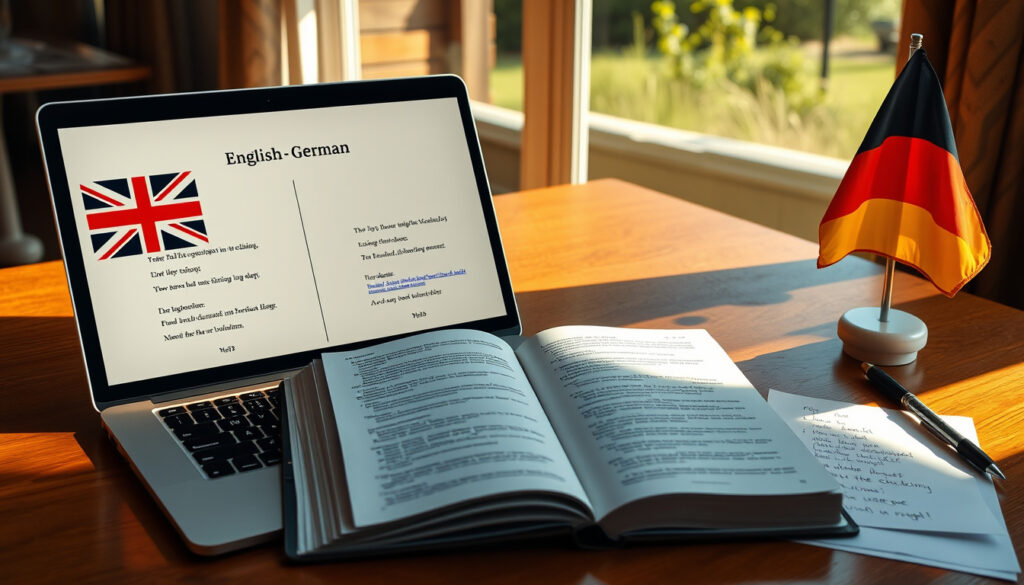
English to German Translation: Tools, Phrases & Tips
Anyone who’s spent time wrestling with German grammar knows the frustration of perfectly correct English coming out scrambled in translation. The issue isn’t usually the tool — it’s understanding what these translators do well, where they stumble, and how to work around the quirks. This guide breaks down what actually works in English to German translation, backed by real benchmarks and learner-tested examples.
Google Translate Languages: 130+ · DeepL Daily Users: millions · Collins Languages Available: over 30 · Translate.com Language Pairs: 5,900+ · Top PAA Questions: 9 unique
Quick snapshot
- DeepL ranks top in 65% of language pairs per Intento benchmark (Smartling)
- DeepL excels in tone and idioms for European languages over Google Translate (Codecademy)
- Es gibt translates existence, not the verb “to be” (UW Law Library)
- DeepL paraphrasing tool launched with terms feature in 2026 (DeepL Official)
- Intento benchmark confirms DeepL top in 65% pairs (Smartling)
- Neural Machine Translation continues improving for German nuance (Pairaphrase)
- ChatGPT integration for post-editing is expanding (Pairaphrase)
The following table summarizes key metrics that define the English-German translation landscape in 2026.
| Metric | Value |
|---|---|
| Most Accurate Tool | DeepL |
| Free Languages Supported | Google: 130+ |
| Example-Driven | Collins Dictionary |
| DeepL Accuracy Score | 9.7/10 |
| Google Translate Accuracy Score | 8.5/10 |
| DeepL Benchmark Leadership | 65% of language pairs |
What does “ich möchte” mean in German?
The phrase ich möchte translates to “I would like” — it’s the polite conditional form of “want” and the correct choice for requests in German. Beginners often confuse it with ich mag (I like), which carries a different meaning entirely.
The distinction matters because German formality rules shape how these verbs behave. Möchte softens a request, while mag expresses ongoing preference. A learner asking for water would say Ich möchte ein Wasser — “I would like a water” — not Ich mag ein Wasser, which sounds like a statement about fondness.
DeepL sometimes renders English “I want” as the blunt Ich will instead of the softer Ich möchte. Always check the formality level when translating requests.
Difference between mögen and möchten
- mögen = to like (state of preference)
- möchten = to want/would like (polite request)
- wollen = to want (direct, sometimes rude)
The implication: using wollen where möchten belongs makes you sound demanding to German speakers. Context matters, and so does the verb choice.
What is the meaning of “Wie heisst du” in German?
Wie heisst du? literally means “What are you called?” — the standard way to ask someone’s name in everyday German conversation. The word heissen (to be called/named) is a regular verb that conjugates directly onto the du (informal “you”).
Basic greetings and introductions
- Wie heisst du? — What’s your name? (informal)
- Wie heissen Sie? — What’s your name? (formal)
- Ich heisse — My name is (literally “I am called”)
The pattern: German speakers use the article der or die before names in certain dialects. You might see Ich bin der Andi — dropping the article sounds unnatural in some regional contexts, though standard German works without it.
In southern Germany and Austria, name introductions often include the definite article. DeepL picks this up inconsistently depending on the formality register you select.
What does “zeitung” mean in English?
Zeitung directly translates to “newspaper” — a compound of Zeit (time/era) and ung (the act of). The word captures the concept of regular publications covering current events, though it can also mean “tidings” in older contexts.
Everyday vocabulary translations
- die Zeitung — the newspaper
- die Nachrichten — the news (broadcast)
- die Meldung — the report/announcement
DeepL correctly translates Zeitung as “newspaper” in most contexts. However, if you input English “dictionary” expecting German output, DeepL sometimes leaves it as “Dictionary” rather than converting to Wörterbuch (Trans-Euro translation analysis).
Why do Germans say “es gibt”?
Germans use es gibt to express existence — “there is” or “there are” — and it’s one of the trickiest constructions for English speakers because it doesn’t map neatly onto English grammar. Where English says “there is a problem,” German says Es gibt ein Problem.
Vs English “there is/there are”
The key difference: es gibt implies “exists” in a broader sense, while English “there is” can mean location OR existence. German separates these concepts. Use sein (to be) for location: Das Buch ist auf dem Tisch (The book is on the table). Use es gibt for existence: Es gibt viele Bücher (There are many books / Many books exist).
What this means: conflating es gibt with location creates grammatically incorrect German. Translation tools handle this inconsistently — DeepL generally gets it right, but complex sentences with embedded clauses can trip it up (UW Law Library translation guide).
Why do Germans say “Ich bin der”?
When a German speaker says Ich bin der Andi, they’re using the definite article der before a name — a grammatical pattern that sounds odd to English ears but is perfectly standard in certain German regions and registers. The article emphasizes identity, almost like saying “I am the Andi” in English.
Name introductions with articles
This article-before-name construction appears most commonly in:
- Southern Germany (Bavaria, Baden-Württemberg)
- Austria and Switzerland
- Informal, regional speech
Standard High German typically drops the article: Ich bin Andi. DeepL recognizes both patterns but defaults to standard usage. If you’re translating dialogue from a Bavarian character, you may need to adjust manually.
DeepL vs Google Translate: Which is better for English-German?
Two tools dominate English-German translation, and they serve different priorities. DeepL leads on accuracy and nuance for European language pairs, while Google Translate covers significantly more languages globally.
| Feature | DeepL | Google Translate |
|---|---|---|
| Languages supported | 30+ | 130+ |
| Accuracy score | 9.7/10 | 8.5/10 |
| Best for | European languages, nuance, tone | Global coverage, non-European languages |
| Benchmark leadership | Top in 65% of pairs | Competitive in language breadth |
| Document formatting | Preserves Word/PPT well | Basic preservation |
| Legal nuance handling | Stronger accuracy | Weaker for specialized terms |
| Free tier limit | 3 editable files/month | Unlimited text, 10 files/page |
DeepL’s neural networks are particularly adept at European language pairs, producing outputs that feel more natural and contextually appropriate. The tool ranks top in 65% of language pairs per Intento benchmarks, with English-German being one of its strongest pairs (Smartling accuracy analysis).
DeepL excels at nuance but supports fewer languages. If you need Indonesian, Arabic, or Tamil, Google Translate covers 130+ languages where DeepL stops at roughly 30. For German specifically, DeepL is the better choice.
Grammar pitfalls to watch for in English-German translation
Both tools share common failure modes that trip up learners and professionals alike.
Upsides
- DeepL preserves HTML tags in translations (XTM integration review)
- DeepL offers glossary features for consistent term use (DeepL feature documentation)
- Both tools handle word order better than earlier statistical MT
- DeepL’s paraphrasing tool supports English and German with key term locking
Downsides
- DeepL doesn’t correct spelling errors in source English text (Trans-Euro hands-on review)
- DeepL often renders English “you” as formal Sie instead of informal Du
- DeepL sometimes omits words or shifts meaning in complex sentences (Trans-Euro hands-on review)
- Google Translate struggles with legal nuances and specialized terminology
“DeepL remains the gold standard for ‘feeling’ human. Its neural networks are particularly adept at European languages.”
— Doctor eLearning, Guide Author (Doctor eLearning translation guide)
“DeepL provides excellent German-English translations. It’s incredibly convenient that you can translate text with HTML tags intact.”
— Verified DeepL user, G2.com reviewer (XTM translation tool comparison)
Related reading: How to Backup Your Computer: Windows & Mac 3-2-1 Guide · Latest Breakthroughs in Quantum Computing 2024: Key Advances
While mastering phrases like ‘ich möchte’ is key, the best English to German tools provide benchmarks for tools like DeepL in handling grammar nuances.
Frequently asked questions
Do Germans say “Wie geht’s”?
Yes — Wie geht’s? (contracted from Wie geht es?) is the everyday equivalent of “How’s it going?” in English. It’s casual, appropriate among friends and acquaintances, and one of the most recognizable German phrases worldwide.
Can I say “Ich bin gut”?
Yes, Ich bin gut means “I am good/well” and is grammatically correct. Germans use it to respond to Wie geht’s? or to describe being skilled at something (Ich bin gut in Mathe = I’m good at math).
What’s German for girl?
The German word Mädchen means “girl.” Unlike English, German nouns have grammatical gender — Mädchen is neuter (das Mädchen) even though it refers to a female person. This confuses learners because the article doesn’t match the biological gender.
What is moo moo in German?
The sound a cow makes in German is Muh (pronounced like “moo”). Muh is the onomatopoeia used in children’s books and casual speech for bovine vocalizations.
How do I translate English sentences to German?
Copy your English sentence into DeepL or Google Translate, select English → German, review the output for formality markers (Du vs Sie), check compound word accuracy, and verify verb placement. For important documents, use a human post-editor to check for nuance errors.
What’s the best English to German translator?
DeepL ranks highest for English-German accuracy (9.7/10) and handles nuance better than competitors. Google Translate covers more languages but scores lower on German accuracy. For professional work, DeepL Pro offers glossary features and document formatting preservation.
More related posts
 Home Store and More Tallaght: Location, Products & Deals
 Is Bread Soda the Same as Bicarbonate of Soda
 Boyle Today Death Notices Roscommon: How to Find Recent Deaths
 How Many Steps in a 5K? Complete Walking vs Running Guide
 Pregnancy Due Date Calculator: Calculate Your Due Date
 TGI Fridays Blanchardstown Menu: Prices, Deals & Opening Hours
 Cast of Wicked: For Good: Full List, Dorothy & Key Roles
 Who Killed Charlie Kirk? Assassination Facts and Updates
