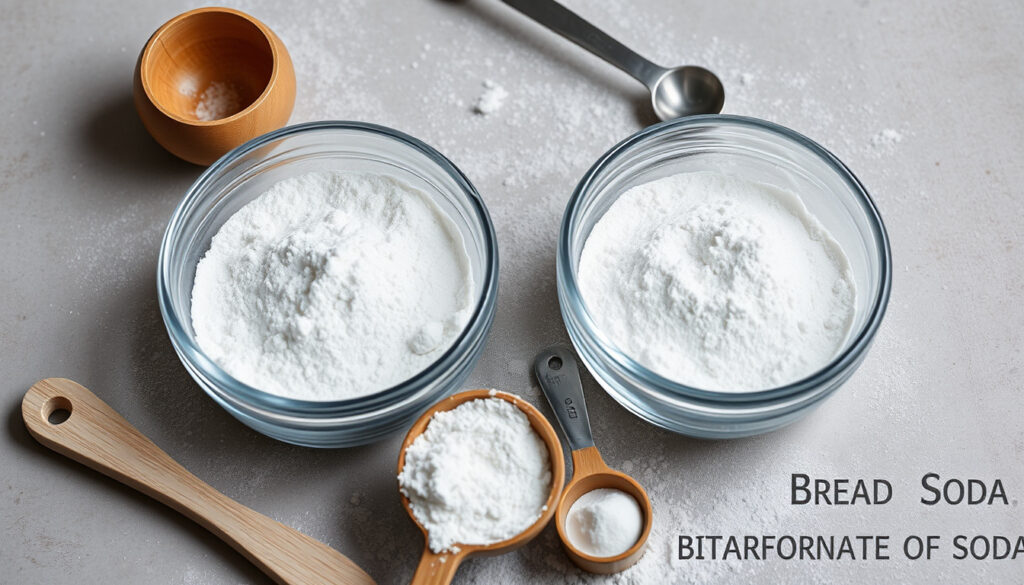
Is Bread Soda the Same as Bicarbonate of Soda
You are probably here because a recipe called for “bicarbonate of soda” and you stared at the shelf, wondering if that was the same as the baking soda you already own. The short answer is yes, but the longer answer involves chemistry, regional vocabulary, and a dash of history.
Key Facts
- Bicarbonate of soda, baking soda, and bread soda are all common names for the same chemical compound: sodium bicarbonate. PubChem (NIH)
- Other names include bicarbonate of soda and bicarb. Wikipedia
- In the US, the most commonly used term is baking soda. Wikipedia
- The UK, Australia, and New Zealand more commonly use bicarbonate of soda. British Dietetic Association
- In Ireland, bread soda is a common local term for sodium bicarbonate in soda bread traditions. Wikipedia – Soda bread
- Sodium bicarbonate has the chemical formula NaHCO₃. PubChem (NIH)
- Primary function is as a leavening agent in baking. USDA AMS
- It reacts with acid to produce CO₂ gas, which helps dough rise. PubChem (NIH)
- Never mix baking soda with bleach or ammonia, as it can produce toxic gases. PubChem (NIH)
- Avoid mixing with baking soda in a sealed container; pressure can cause explosions. PubChem (NIH)
Chemical formula: NaHCO₃ · Common aliases: Baking soda, bread soda, bicarb, sodium bicarbonate · Primary function: Leavening agent in baking · Reaction with acid: Produces CO₂ gas for rise · Shelf life: Indefinite when sealed dry
Is bread soda the same as bicarbonate of soda?
To settle the primary question: Yes, “bicarbonate of soda” and “baking soda” are chemically identical. Both are sodium bicarbonate, with the formula NaHCO₃. The difference is purely a matter of regional vocabulary and marketing. The term most commonly used in the US is “baking soda,” while the UK, Australia, and New Zealand more commonly use “bicarbonate of soda.” In Ireland, the term “bread soda” is a colloquial favorite, especially in reference to traditional soda bread. This is not a case of different formulations—it is the same ingredient with multiple names.
Wikipedia notes that the term most commonly used is baking soda. This is further supported by British Dietetic Association, which states that in the UK, “bicarbonate of soda” is the standard name used in official dietetics content. Regardless of what you call it, the chemical substance remains exactly the same.
“Bicarbonate of soda, or baking soda, is an alkali which is used to raise soda breads and full-flavoured cakes.” — BBC Good Food glossary
The table below outlines the regional naming preferences, which is where the recipe confusion typically originates.
| Region | Common Term | Chemical Identity |
|---|---|---|
| United States | Baking Soda | Sodium Bicarbonate (NaHCO₃) |
| United Kingdom | Bicarbonate of Soda | Sodium Bicarbonate (NaHCO₃) |
| Ireland | Bread Soda | Sodium Bicarbonate (NaHCO₃) |
| Australia & New Zealand | Bicarbonate of Soda / Bicarb | Sodium Bicarbonate (NaHCO₃) |
The table confirms that while the names vary by market, the ingredient is chemically identical everywhere. The variation is purely linguistic, not functional.
The reality is that a recipe from Dublin, London, or New York will work with the same ingredient as long as you recognize the local name. This is the key takeaway for any home baker.
Regional Terminology: Why the Names Differ
Understanding the regional terms is less about chemistry and more about cultural history. The Wikipedia entry on soda bread points out that in Ireland, “bread soda” is a common local term, reflecting the ingredient’s essential role in the country’s iconic soda bread. The term is a direct reference to its function—it is the soda used for bread.
The British Dietetic Association (BDA) uses “bicarbonate of soda” in its official UK-facing guidance, referencing the traditional name that British and Irish bakers have used for generations. This distinction is not universal—in the US, the term “baking soda” is nearly exclusive. The geographic split is the primary driver of recipe confusion, not any chemical difference.
What is baking soda in Ireland called?
In Ireland, baking soda is most commonly called bread soda. The term originates from its essential role in traditional Irish soda bread. Other names such as bicarbonate of soda or bicarb are also understood but less common in everyday household use.
When a recipe says “bicarbonate of soda,” the author is likely from the UK, Australia, or New Zealand. If a recipe says “bread soda,” it is probably an Irish recipe. Recipes from the US will almost always say “baking soda.” This is the map that bakers need to navigate.
The key to successful baking is understanding that these regional names are interchangeable. A UK recipe calling for “bicarbonate of soda” will react identically to a US recipe calling for “baking soda.” The leavening power and the chemical reaction are the same, so there is no need to make any adjustments.
The palate of names is broader than just English. In some countries, the ingredient is called “sodium bicarbonate,” which is simply the international chemical name. This is less common in everyday recipes but shows the universal nature of the compound.
The trade-off between terms is a matter of audience and origin. The clearest path is to recognize the regional context of your recipe and translate accordingly.
The Chemical Truth: Baking Soda vs. Baking Powder
A common point of confusion is the difference between baking soda (sodium bicarbonate) and baking powder. While they are both leavening agents, they are not the same. Baking soda is pure sodium bicarbonate and requires an acid (like buttermilk, vinegar, or lemon juice) to react and produce carbon dioxide. Baking powder, on the other hand, contains baking soda plus an acid (usually cream of tartar) and a starch (like cornstarch) to absorb moisture. This means baking powder is a “double-acting” leavener that works in two phases: once when combined with liquid and again when heated.
“Baking soda and bicarb soda refer to the same thing. Australia, New Zealand and the UK use the term bicarb soda, while the US refers to it as baking soda.” — Taste.com.au article
According to the PubChem (NIH), sodium bicarbonate functions as a processing aid and pH control agent in food. The Wikipedia article on the compound explains that a 2026-updated BakingwiseHub article states bread soda, bicarbonate of soda, and baking soda are the same conventional rather than chemically distinct ingredient. This means that recipes in the UK commonly specify bicarbonate of soda rather than baking powder, while US recipes are more likely to specify baking powder.
What can I substitute for bicarbonate soda?
If you need a substitute for bicarbonate of soda (baking soda) in a recipe, baking powder is the most common option. Because baking powder contains its own acid, you need to adjust the ratio: use 3 teaspoons of baking powder for every 1 teaspoon of bicarbonate of soda. Self-rising flour is another alternative; it already contains baking powder and salt, so omit any additional salt. For recipes that already include an acidic ingredient like buttermilk or yogurt, you can add extra baking soda to boost the reaction, but careful adjustment is required.
The table below compares the composition and uses of these two common ingredients.
| Leavening Agent | Composition | Requires Acid? | Common Use |
|---|---|---|---|
| Baking Soda | Pure sodium bicarbonate | Yes | Recipes with acidic ingredients |
| Baking Powder | Sodium bicarbonate, cream of tartar, cornstarch | No (self-contained) | General-purpose baking |
This table highlights that baking powder is the more convenient, self-contained option for most recipes, while baking soda is specifically useful when a recipe already includes an acid. The chemical mechanisms are well documented and universally accepted.
The practical consequence is that you cannot use one in place of the other without adjusting the recipe. If substitute for baking powder with baking soda, you would need to add an acid to activate the leavening. Conversely, if you use baking powder in a recipe that calls for baking soda, the final product might have a slightly metallic aftertaste due to the excess acid in the powder.
Safety and Handling: The Crucial Do Nots
Given its chemical nature, there are critical safety precautions to observe. The most important rule is never to mix baking soda with vinegar and then seal the container. This produces carbon dioxide gas, which can build up pressure and cause an explosion. Similarly, do not mix with bleach or ammonia, as this can create toxic gases. The PubChem (NIH) data indicates that sodium bicarbonate is generally safe for consumption, but the reactions it causes are not safe in confined spaces.
What should you never mix with baking soda?
Never mix baking soda with bleach or ammonia, as the chemical reaction can release toxic gases. Additionally, avoid mixing it with an acid (like vinegar) in a sealed container, as the rapid release of carbon dioxide can cause a pressure explosion. These warnings are consistent across all sources and regional naming conventions.
What happens when you mix baking soda and vinegar?
Baking soda (a base) reacts with vinegar (an acid) to produce carbon dioxide, water, and acetate. This reaction is often used for cleaning because the gas bubbles help lift dirt. In baking, the same reaction provides quick leavening when combined in batter. However, it should never be done in a sealed container due to explosion risk.
The key safety warnings are summarized in the table below.
| Substance | Reaction with Baking Soda | Risk |
|---|---|---|
| Vinegar | Produces carbon dioxide + water | Pressure explosion risk in sealed containers |
| Bleach (Sodium hypochlorite) | Produces toxic chloramine gas | Severe respiratory irritation |
| Ammonia | Produces toxic ammonia gas | Irritation to eyes, skin, airways |
| Hydrogen Peroxide | Produces oxygen gas | Possible pressure buildup |
This table outlines the specific hazards, which is particularly important when using cleaning products near baking ingredients. The warnings from the British Dietetic Association emphasize that when used in food, the quantities are safe, but concentrated chemical exposure can be harmful.
The main takeaway is that while baking soda is a safe and versatile ingredient in cooking, its chemical relatives and combinations are not all safe. Always use it in a well-ventilated area and never mix it with household cleaners.
Related reading: Is Baking Soda the Same as Bicarbonate of Soda
bakewisehub.com, bakewisehub.com, irelanddispatch.org, irelandupdate.net
Frequently Asked Questions
Is bicarbonate of soda the same as baking soda?
Yes, they are exactly the same chemical compound: sodium bicarbonate (NaHCO₃). The difference is purely linguistic, with “baking soda” being the dominant term in the US and “bicarbonate of soda” the preferred term in the UK and other Commonwealth countries. Ireland also uses “bread soda” in the context of traditional Soda Bread recipes.
What is the difference between “bicarbonate of soda” and “baking soda” in recipes?
For all practical purposes, there are no differences. One can be substituted for the other in a 1:1 ratio. The only reason to pay attention is to double-check the recipe. If it asks for one of these terms, use the exact same ingredient. The recipe is not asking for something inherently different.
Can I substitute bread soda for baking soda?
Yes, absolutely. “Bread soda” is just a colloquial term for the exact same substance. The only consideration is that “bread soda” is a term used in Ireland, so you may see it in Irish recipes. As long as you are using pure sodium bicarbonate, the substitution is perfect.
What happens if you use no baking soda?
If you omit baking soda from a recipe that calls for it, the final product will likely be dense and flat. The leavening reaction is essential for the rise. Without it, the recipe will lack the necessary lift, resulting in a heavy texture that is usually too dense and chewy.
Is baking soda or bicarbonate of soda better for cleaning?
Since they are the same substance, neither has a distinct advantage. The term “baking soda” is often used in the context of cleaning products to make them sound more friendly, but the chemical is the same across all names. The specific use case should guide what you buy, but the choice of name does not change the chemical’s cleaning power.
The Regional Recipe Map: A Mini-Glossary
Beyond the basic equivalence, it is helpful to see the ingredients in the context of local recipes. For example, in a traditional Irish soda bread, the ingredient is often listed as “bread soda,” and the recipe will have you buttermilk or sour milk. This acid is essential for reacting with the bicarbonate to make the bread rise. The same recipe in the US would call it “baking soda” and be nearly identical otherwise. The Wikipedia piece on soda bread highlights this practical, cross-regional application.
Similarly, in the UK, a packet of biscuits (cookies) might call for “bicarbonate of soda,” while an American cookbook would say “baking soda.” The difference never matters in the baking process itself; it only matters at the supermarket checkout.
The confusion often extends to whether these terms refer to the same thing as “bicarbonate of soda” in a non-baking context. For example, the chemical compound used as an antacid or in cleaning products is also sodium bicarbonate. In the baking supply aisle, you are buying the same pure chemical, regardless of the label.
This is the map of terminology that every international recipe navigator must internalize: it is a linguistic map, not a chemical one.
When in doubt, check the chemical name on the back of the package. If it says “sodium bicarbonate” (with no other leavening ingredients), you are holding the right product.
Why This Matters for Your Baking
Understanding this equivalence is more than just trivia; it directly impacts your success in the kitchen. When you encounter a recipe that doesn’t match your local naming convention, you can proceed with confidence, knowing that the ingredient is the same. This is crucial for achieving the desired texture in baked goods, as a proper rise depends on the correct chemical reaction.
For instance, if a recipe from an Australian website calls for “bicarb” and you’re in the US, you do not need to search for a new recipe. You can simply measure out the same amount of baking soda. This saves time and ensures you don’t miss out on a good recipe.
Moreover, there is a broader cultural aspect to this knowledge. Food is tied to heritage, and being able to decipher these names allows you to connect with the culinary traditions of other English-speaking countries. You are not just following a recipe; you are part of a global community of bakers who share the same pantry staples under different labels.
The confidence this provides cannot be overstated. The next time you see “bicarbonate of soda” in a recipe, you can smile, knowing that it is a friend you’ve met before, just with a different name tag.
This is the quintessential kitchen argument for understanding your ingredients: it converts a moment of doubt into a moment of certainty.
The Takeaway on Homemade Cleaning Pastes
This is not to say that the same product is always labeled identically in every context. In the world of DIY cleaning, the name “bicarbonate of soda” is often explicitly chosen to align with marketing that emphasizes its chemical nature, while “baking soda” sounds more approachable. This further cements the idea that they are two brand names for the same chemical, and the consumer is expected to know this.
The same brand might even market the same product under each name in different countries. This is a common strategy for global brands that have to navigate local vocabulary norms. A product that is a top seller in the US as “baking soda” might be the best-seller in the UK as “bicarbonate of soda,” despite being chemically identical.
It is a simplification to say one name is “more correct” than another. Both are accurate, but neither is as precise as the chemical name. However, in a recipe, you will almost never see “sodium bicarbonate” listed. Instead, you will see the common name, tailored to the target audience.
This is a text-book example of how the same product can be tailored to different markets just by changing the label.
Understanding this allows you to shop smarter and bake better, no matter which dialect of English you speak.
Confirmed facts
- Chemical formula: NaHCO₃ PubChem (NIH)
- Common synonyms: Baking soda, bicarbonate of soda, bread soda, sodium bicarbonate Wikipedia
- Primary use in baking: Leavening agent USDA AMS
- Distinct from baking powder: Yes – baking powder contains added acid British Dietetic Association
- Ireland: bread soda Wikipedia – Soda bread
- UK, Australia, NZ: bicarbonate of soda British Dietetic Association
- US: baking soda Wikipedia
- Never mix with vinegar in a sealed container PubChem (NIH)
- Never mix with bleach or ammonia PubChem (NIH)
What’s Unclear
- Whether commercial brands differ in particle size or purity beyond food grade. BakingwiseHub
- Exact origin of the term “bread soda” (first use in Irish soda bread). SodaBread.info
Understanding the regional naming and chemical identity of sodium bicarbonate builds confidence in any kitchen. Whether you call it bread soda, bicarbonate of soda, or baking soda, the same ingredient delivers the same leavening power. That certainty turns confusion into successful baking.
More related posts
 Black Air Force 1: Price, History & Hype Explained
 How to Download YouTube Videos: Best Free Methods and Tools
 Public Services Card Ireland 2025: How to Apply
 Dacre Montgomery Movies and TV Shows: Complete Guide
 Kpop Demon Hunters Colouring Pages – Free Printable Collections for Fans
 Homestore and More Galway: Hours, Phone, Specials & Clearance
 Man Utd vs Liverpool – Preview, Predictions and Team News
 Dunnes Stores Midi Dress 2025: Prices, Colors & Occasions
