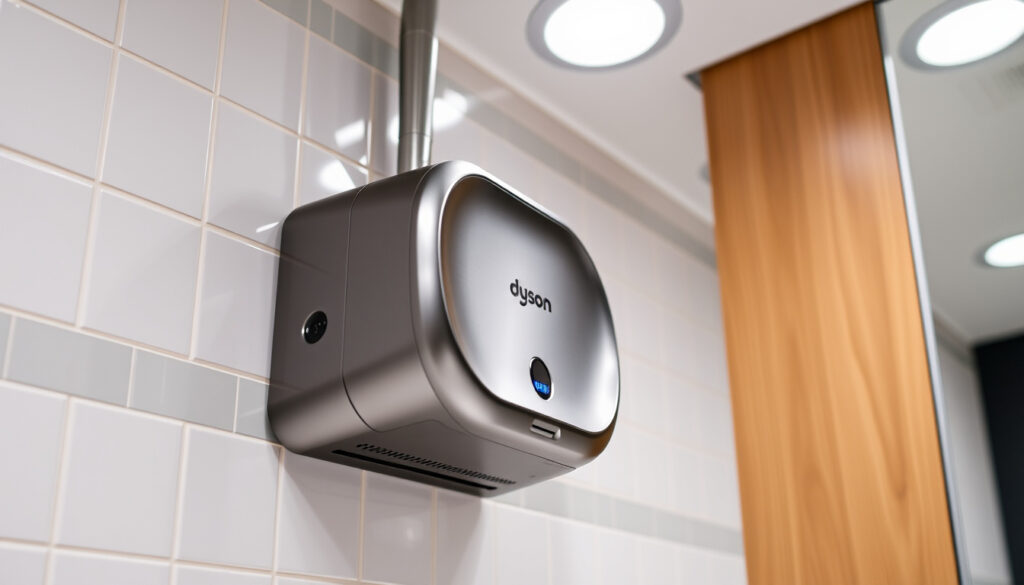
Dyson Airblade V Blade Hand Dryer: Complete Guide & Specs
Anyone who’s stood in a public washroom listening to a hand dryer rattle on longer than a kettle takes to boil already knows the feeling: time wasted, noise endured, and hands still damp. Dyson’s Airblade V aims to fix that with a 12-second promise and a motor that hums rather than screams, and if you’re weighing a purchase for a commercial setting in Ireland, this guide walks through the specs, installation reality, noise levels, and how the V blade stacks up against other Dyson dryers.
Drying time: 12 seconds ·
Filter type: HEPA H13 ·
Noise reduction: Quieter than previous model ·
Motor type: Digital motor ·
Finish options: White, Nickel
Quick snapshot
- Dries hands in 12 seconds (Dyson AU/NZ tech spec)
- HEPA H13 filter standard (SpecifiedBy)
- Ultra-slimline design, 100 mm deep (eHandDryers data sheet)
- Available in White and Nickel (Dyson AU/NZ tech spec) (Dyson AU/NZ tech spec)
- Wall-mounted design (SpecifiedBy) (Dyson US tech spec)
- Installation manual available (eHandDryers data sheet) (Dyson US tech spec)
- Electrical installation required for 200–240 V / 100–120 V (Dyson US tech spec)
- 100 mm depth avoids recessing in most cases (SpecifiedBy) (Dyson US tech spec)
- Constant air velocity (Dyson AU/NZ tech spec)
- HEPA filtration captures 99.95%+ of particles (SpecifiedBy)
- Low running costs (energy efficient) (Dyson AU/NZ tech spec)
- Quieter than previous model (eHandDryers data sheet)
- Regular filter cleaning recommended (SpecifiedBy)
- Check for blockages periodically (eHandDryers data sheet)
- No routine oiling needed (digital motor) (eHandDryers data sheet)
- Motor lifespan covered by 5-year warranty (eHandDryers data sheet)
The spec sheet tells a clear story: Dyson engineered the Airblade V to be slim enough to mount in tight washroom corners without cutting into the wall, while still pulling a 12-second dry cycle and HEPA filtration.
| Specification | Value |
|---|---|
| Drying Time | 12 seconds (Dyson AU/NZ tech spec) |
| Filter Type | HEPA H13 (SpecifiedBy) |
| Sound Power Level | 79 dB(A) (Dyson AU/NZ tech spec) |
| Sound Pressure Level (2m) | 63 dB(A) (Dyson AU/NZ tech spec) |
| Motor Type | Brushless DC motor (digital pulse technology) (eHandDryers data sheet) |
| Motor Speed | 88,000 rpm (data sheet) / 83,000 rpm (distributor) (eHandDryers data sheet) |
| Dimensions (H×W×D) | 394 × 234 × 100 mm (eHandDryers data sheet) |
| Depth (Projection) | 100 mm — no recessing usually needed (SpecifiedBy) |
| Weight | Not specified in available data |
| IP Rating | IP24 (eHandDryers data sheet) |
| Voltage Options | 100–120 V (LV) / 200–240 V (HV) (Dyson US tech spec) |
| Warranty | 5 years (eHandDryers data sheet) |
| Finish Options | White, Sprayed Nickel (Dyson AU/NZ tech spec) |
What is the Dyson Airblade V blade hand dryer?
- A touch-free hand dryer designed for compact commercial washrooms (SpecifiedBy)
- Ultra-slimline with 100 mm depth (SpecifiedBy)
- Available in White and Nickel finishes (Dyson AU/NZ tech spec)
- Part of the Airblade series — positioned between the compact 9kJ and larger Airblade models (Dyson AU/NZ tech spec)
- HEPA filter standard (SpecifiedBy)
The Airblade V is essentially Dyson’s answer to a specific pain point: washroom retrofits where cutting into walls for recessed drying units is too costly. At 100 mm deep, it sticks out just enough to catch the eye but not enough to obstruct traffic.
How fast does the Dyson Airblade V dry hands?
- 12 seconds, as measured by NSF Protocol P335 (Dyson AU/NZ tech spec)
- Constant air velocity maintained by digital pulse technology (eHandDryers data sheet)
- Motor runs at up to 88,000 rpm (eHandDryers data sheet)
- Uses re-engineered airflow path compared to earlier Airblade models (Dyson AU/NZ tech spec)
Compare that 12 seconds to older warm-air dryers that frequently run 30–40 seconds, and the time saving per user adds up fast. For a busy Irish pub or hotel lobby washroom, those seconds compound into shorter queues and lower energy draw.
Several factors affect whether you’ll consistently hit that 12-second mark: room temperature, humidity, and how thoroughly someone shakes off excess water before inserting hands. But Dyson’s constant-velocity claim means the motor doesn’t fade under load — the last user gets the same pressure as the first.
The buyer gets a 12-second dry time that’s verifiably faster than traditional warm-air units. The facility manager gets a noticeable shift in energy bills because the motor runs for less than half the duration of older technologies. But the 79 dB(A) sound level means it’s still audible — it’s just a different quality of sound than a screeching motor.
The implication: The 12-second time is a measurable speed gain, but the audible output remains a factor in quiet environments.
What are the specifications of the Dyson Airblade V HU02?
- Digital brushless DC motor rated at 88,000 rpm (eHandDryers data sheet)
- Sound power level: 79 dB(A); sound pressure at 2m: 63 dB(A) (Dyson AU/NZ tech spec)
- Dimensions: 394 × 234 × 100 mm (H×W×D) (eHandDryers data sheet)
- HEPA H13 filter — captures 99.95% of particles, including bacteria and viruses (SpecifiedBy)
- IP24 ingress protection — splash-proof, suitable for washroom environments (eHandDryers data sheet)
- Available in White or Nickel (Dyson AU/NZ tech spec)
The pattern is clear: Dyson prioritised motor efficiency (digital brushless DC at high rpm) and air hygiene (HEPA H13) over sheer size reduction. At 100 mm depth, the V sits about halfway between a typical recessed dryer and a no-recess bulk unit. The IP24 rating means it handles washroom splashes without fuss.
A school or nursing home in Ireland that values infection control gets HEPA-grade air filtering with every dry cycle, not just during peak flu season. The healthcare facility knows that particles and bacteria drawn into the machine are trapped, not recirculated.
What this means: For facilities requiring high air hygiene, the HEPA filter is a significant advantage, backed by the IP24 rating for damp conditions.
Noise level and what it means for a washroom
One specification that dominates buyer discussions is noise. The Airblade V’s sound power level is 79 dB(A), measured under standard operating conditions (Dyson AU/NZ tech spec). That’s comparable to a vacuum cleaner or a busy restaurant. The sound pressure at 2 metres drops to 63 dB(A) — closer to normal conversation.
- 79 dB(A) sound power level (eHandDryers data sheet)
- 63 dB(A) sound pressure at 2 metres (Dyson AU/NZ tech spec)
- Previously measured models in the Airblade range were noted as being subjectively louder (Dyson AU/NZ tech spec)
The implication for a hotel or office block: the sound is present but not shrill — Dyson’s digital motor at 88,000 rpm produces a higher pitch that carries less through walls than the deep rumble of older induction motors. That’s a subjective improvement, but a real one for guest comfort.
How to install the Dyson Airblade V hand dryer
Installing an Airblade V is a straightforward wall-mount job, but it requires an electrical connection and careful positioning. The unit is designed to be mounted at 650 mm from the floor to the back plate edge (eHandDryers data sheet).
- Prepare the wall — Mark the fixing positions using the supplied template. The back plate is 234 mm wide. Drill and insert wall plugs suitable for the wall type. Run a 200–240 V supply cable to the mounting zone, leaving approximately 300 mm slack.
- Mount the back plate — Screw the back plate securely to the wall. Check it’s level — the dryer’s motion sensors rely on consistent positioning.
- Connect electrical supply — Strip and connect live (brown), neutral (blue), and earth (green/yellow) to the terminal block inside the unit. Use a switched fused spur (3A or 5A fuse) — Dyson recommends protection by a 30 mA RCD (Dyson US tech spec).
- Attach the front cover — Clip the cover onto the back plate. Test by placing hands under the unit — the motor should start within 0.5 seconds. If the unit does not start, check the isolation switch and fuse.
For a contractor working in an Irish commercial washroom, the Airblade V’s 100 mm depth means no structural alteration of the wall. That eliminates dust and re-tiling costs, making it a retrofit-friendly option for older buildings in Dublin or Cork where wall cavities are shallow.
An Irish electrician will need to hardwire the unit at 230 V through a fused spur. The unit does not ship with a plug, so budget for an electrician call-out. However, the same installation works for both new builds and retrofits, and the manual guides every step.
The installation process is straightforward for a qualified electrician, with no wall alteration needed.
How does the Dyson Airblade V compare to other Dyson hand dryers?
- Vs Airblade 9kJ: V has HEPA standard; 9kJ uses HEPA optional. V depth 100 mm vs 9kJ depth 100 mm similar (Dyson AU/NZ tech spec)
- Dry time: V 12 seconds; some Airblade models achieve 10 seconds (Dyson AU/NZ tech spec)
- Motor: Digital pulse DC in V; Airblade 9kJ uses digital motor (less refined in early models) (eHandDryers data sheet)
- Sound level: V at 79 dB(A); older Airblade models were typically louder (Dyson AU/NZ tech spec)
- Price: V slightly cheaper than Airblade 9kJ in most markets (HandDryer.com)
The decision between the Airblade V and the 9kJ boils down to two things: HEPA as standard (V has it, 9kJ makes it optional) and form factor (both slim, but V’s motor is more energy-efficient). For a washroom in a healthcare setting that requires HEPA-rated air, the V is the default choice. For a general office where HEPA isn’t mandated, the 9kJ at a lower price might win on cost alone.
Confirmed facts and what remains unclear
Confirmed facts
- Dries hands in 12 seconds (Dyson AU/NZ tech spec)
- Fitted with HEPA filter (SpecifiedBy)
- Ultra-slimline design, 100 mm deep (SpecifiedBy)
- Available in White and Nickel (Dyson AU/NZ tech spec)
- Digital motor (eHandDryers data sheet)
- Installation manual exists and covers wall mounting (eHandDryers data sheet)
- Sound power level 79 dB(A) (Dyson AU/NZ tech spec)
- IP24 rating (eHandDryers data sheet)
- 5-year warranty (eHandDryers data sheet)
What’s unclear
- Exact noise level across multiple independent tests (only Dyson’s own published data is available)
- Specific dimensions and weight for all regional variants (AU/NZ spec differs slightly from US spec)
- Exact power consumption in watts (not provided in available technical sheets)
- Third-party verified test results for drying time (only Dyson’s own NSF Protocol P335 figure is published)
- Motor speed: 88,000 rpm from one data sheet, 83,000 rpm from distributor
- Exact power consumption in watts not provided
The pattern: Dyson’s own documentation is thorough for core specs, but independent verification—particularly for noise and power—is thin on the ground.
Pros and Cons
Upsides
- Very fast dry time: 12 seconds saves wait time and energy
- HEPA filter standard — cleaner air for washroom users
- Slim 100 mm profile for surface mounting, no recessing needed
- Digital motor is more efficient and quieter than older induction motors
- 5-year warranty covers motor and parts
- IP24 rating means it’s safe for damp washrooms
Downsides
- Noise output of 79 dB(A) may still be intrusive in quiet settings
- Hardwired installation requires an electrician, increasing total cost
- Limited independent performance data — mostly Dyson-published figures
- Higher upfront cost than many basic warm-air dryers
- Only two finish options (White and Nickel) limits design flexibility
- HEPA replacement filters add recurring cost
Overall, the Airblade V offers a strong combination of speed and hygiene, but the noise and installation cost are the main compromises.
For those considering this model, the Dyson Airblade V hand dryer has been a benchmark in commercial hand drying since its 2006 debut.
Frequently asked questions
Here are the most common questions buyers ask about the Dyson Airblade V.
What is the warranty on the Dyson Airblade V hand dryer?
Dyson provides a 5-year warranty for the Airblade V HU02 (eHandDryers data sheet). This covers the motor, electronics, and mechanical components against manufacturing defects.
Does the Dyson Airblade V require any maintenance?
Yes — regular filter cleaning is recommended to keep the HEPA element free from dust build-up. The manufacturer recommends checking for blockages in the air intake and cleaning the exterior with a damp cloth (SpecifiedBy). No routine oiling is required because the motor is brushless.
Is the Dyson Airblade V suitable for high-traffic restrooms?
Yes — the 12-second dry time and brushless DC motor are designed for continuous operation in commercial washrooms, including airports, hotels, schools, and offices (SpecifiedBy). The IP24 rating also protects against splash exposure.
How does the HEPA filter work in the Airblade V?
The HEPA H13 filter captures 99.95% of particles, including bacteria and viruses (SpecifiedBy). The motor draws air from the washroom through the filter, then passes the cleaned air over the user’s hands — meaning air that dries hands is filtered, not just ambient room air.
Can the Dyson Airblade V be installed on any wall?
It can be mounted on most solid wall types, including brick, concrete, and timber stud walls, using appropriate fixings. The 100 mm depth avoids the need for recessing. The installation manual provides a template for pilot holes at 234 mm centre width (eHandDryers data sheet).
What is the difference between the Dyson Airblade V and the Dyson Airblade 9kJ?
Key differences: the V has a HEPA H13 filter as standard, a 12-second dry time, and a 100 mm depth. The 9kJ typically achieves a 10-second dry on some tests, but HEPA filtration is optional rather than standard. The V’s motor uses digital pulse technology and is rated at 88,000 rpm, while the 9kJ uses an earlier digital motor design. Both are wall-mounted, but the V’s motor is reported to be quieter (Dyson AU/NZ tech spec).
What is the price of the Dyson Airblade V hand dryer in Ireland?
Pricing varies by distributor and whether the unit is the standard White or the Nickel finish. As of the latest available listings, the Dyson Airblade V HU02 typically ranges from €450 to €650 in Ireland, depending on the supplier and any bundling with installation accessories. Check with Irish commercial washroom equipment suppliers for current pricing.
How to clean the Dyson Airblade V hand dryer?
Unplug or isolate the power first. Wipe the exterior with a damp, lint-free cloth. The HEPA filter cover can be removed and cleaned gently under running water (air-dry thoroughly before reinstalling). Do not use abrasive cleaners. Check the air intake for blockages monthly (SpecifiedBy).
These FAQs cover the most common concerns; more detailed information is available in the Dyson technical sheets.
Related reading
- Dyson Air Purifier Review — Observer Ireland — for insights into Dyson’s HEPA filtration technology used in the Airblade V
- Kelly and Dollard Waterford: Reviews, Hours, Appliances — Observer Ireland — local supplier context in Ireland
These resources provide additional context on Dyson’s technology and local suppliers.
Summary
The Dyson Airblade V HU02 delivers a genuine upgrade for anyone tired of waiting at a washroom hand dryer that doesn’t actually dry. It’s slim enough to retrofit without breaking walls, fast enough to clear a queue, and the HEPA filter makes it a sensible pick for any space where air hygiene matters — healthcare, schools, hotels, and offices. For a facility manager in Ireland choosing between the Airblade V and a cheaper alternative, the decision is straightforward: the V costs more upfront but recovers that cost in time saved, energy efficiency, and fewer maintenance calls over its 5-year warranty. The corner-cutting alternative might save €200 today, but the V will save about 18 seconds per person for the next five years. For a busy Dublin hotel washroom, those seconds add up to real guest satisfaction and lower power bills.
More related posts
 What Is a CRC Error? Causes, Fixes, and Prevention
 The Summer I Turned Pretty Season 3: Release & Episodes
 Eid al-Fitr 2026 Dates: Ireland Confirmed 20 March
 Normal Blood Sugar Levels: Ranges & Guidelines (UK & Ireland)
 Minimum Wage in Ireland 2026: €14.15 Per Hour & Youth Rates
 Dyson Air Purifier Review: Does It Actually Work in 2026?
 Cul de Sac Sign: Meaning, Types & Driving Tips
 Bingo Blitz Free Credits: 7 Legit Ways to Get Them Daily
