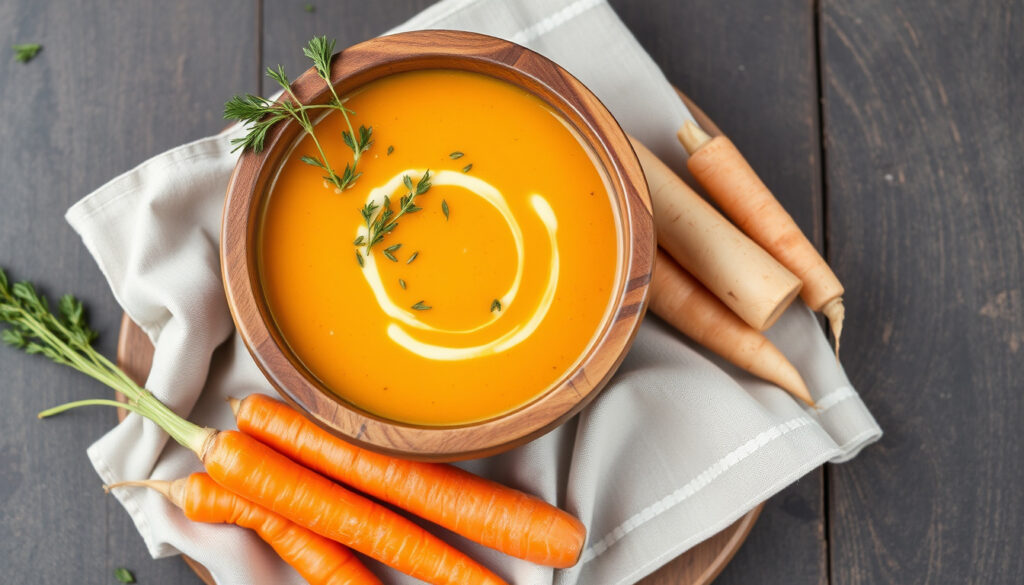
Carrot and Parsnip Soup: Tips, Recipe & Nutrition Guide
There’s a reason so many of us keep coming back to this particular soup when the temperature drops. A bowl with roasted carrots and parsnips feels like a small, affordable luxury — yet getting the balance right (sweetness, spice, texture) is a matter of a few practical choices. This guide answers the most common questions from the kitchen counter: how to build flavor, when to peel, and what each root vegetable actually brings to your bowl.
Calories per serving: 113 kcal ·
Protein per serving: 2 g ·
Carbohydrates per serving: 15 g ·
Total cooking time: 50 min ·
Servings: 4 ·
Preparation time: 10 min
Quick snapshot
- Peeling older, thicker-skinned parsnips is recommended to avoid woody texture (BBC Food)
- Roasting carrots and parsnips before simmering enhances their natural sweetness (Stephanie Kay Nutrition)
- Parsnips contain more fiber than carrots per 100 g (USDA SNAP-Ed Connection)
- Carrots are the richer source of vitamin A among the two (USDA SNAP-Ed Connection)
- Whether parsnips are “healthier” than potatoes depends entirely on your dietary goals — potassium and vitamin C versus complex carbohydrate load (USDA SNAP-Ed Connection)
- The “optimal” spice blend is subjective; preferences vary between warm (cumin, coriander) and fresh (ginger, chili) profiles (USDA SNAP-Ed Connection)
- Most healthy soup recipes land at 40–50 minutes total, with 10–15 minutes of prep and 30 minutes of cooking (My Weekend Kitchen)
- Simmer time with the lid on runs 20–25 minutes until tender (BBC Food)
- Test variations: creamy coconut milk, spicy chili, or a vegan stock base to match your taste (Primavera Kitchen)
- Batch cook and freeze portions for a high-fiber, low-effort weekday meal (Primavera Kitchen)
| Label | Value |
|---|---|
| Calories per serving | 113 kcal |
| Total time | 50 minutes |
| Servings | 4 |
| Carrot beta-carotene content | Very high |
| Parsnip fiber content | Higher than carrots |
Five questions, one pattern: most soup failures trace back to skipping the roast, uneven peeling, or under-seasoning with acid. Here’s how to get each step right.
What to put in carrot and parsnip soup?
Essential ingredients
- Carrots and parsnips are the core root vegetables — BBC Food uses them in a classic blended style, simmering with the lid on for 20–25 minutes
- Onion and garlic are typical aromatics; sauté them first — Larder Love recommends about 5 minutes before adding other ingredients
- Vegetable or chicken stock forms the liquid base
Optional additions for flavor
- Ginger and chili add warmth for a spiced version
- Coconut milk or cream adds richness — try a Primavera Kitchen style with coconut milk
Liquid base options
- Vegetable stock keeps it vegan-friendly; chicken stock adds depth
- Lemon juice after blending brightens the flavor — Good Health Gourmet recommends adding it to adjust seasoning
The implication: the base structure is forgiving, but the aromatics and stock quality carry the dish. Don’t skip the onion-garlic sauté step.
What is the secret to good carrot soup?
Roasting for depth
- Roasting carrots and parsnips before simmering intensifies their natural sweetness and adds caramelized notes (Stephanie Kay Nutrition)
- This step transforms a flat, watery soup into a round, savory one
Balancing sweetness and acidity
- A squeeze of lemon juice after blending corrects the sweetness and brightens the whole pot (Good Health Gourmet)
Proper seasoning
- Salt and pepper are non-negotiable — they elevate the root vegetables’ flavor
- Quality stock makes a real difference; a good vegetable stock adds depth without extra salt
The “secret” isn’t a single ingredient — it’s the roast-and-acid combo. The sugar from roasting caramelizes, while lemon juice cuts through the sweetness, creating contrast that makes the soup pop.
Why this matters: home cooks often blend raw vegetables and wonder why the soup is bland. Roasting first is the fix.
Should I peel parsnips before putting in soup?
Peeling vs. scrubbing
- Peeling is recommended for older, thicker-skinned parsnips to avoid a woody, fibrous texture (BBC Food)
- Young, tender parsnips can be scrubbed well and kept whole — the skin is thin and edible
Texture considerations
- Unpeeled parsnips give a slightly earthier flavor and a more rustic texture
- Peeled parsnips blend into a silkier, smoother soup
Nutritional impact
- Peeling removes some fiber and nutrients, but the difference is marginal for most recipes
- The parsnip’s fiber content — 7 g per 100 g — remains substantial even after peeling (USDA SNAP-Ed Connection)
The trade-off: peel older parsnips for texture, keep young ones scrubbed for nutrition. The flavor difference is subtle; the texture difference isn’t.
What spices go well in parsnip soup?
Warm spices
- Cumin, coriander, and turmeric are popular choices — they complement the root vegetables’ earthiness
- Nutmeg or cinnamon work in small amounts for a gentle warmth
Herb pairings
- Thyme and rosemary pair well with roasted root vegetables
Heat level choices
- Chili flakes or cayenne add heat for a spicier version (Primavera Kitchen)
- Ginger adds a fresh, fragrant sharpness
What this means: start with cumin and coriander for a balanced, warming profile — then adjust heat to taste. The spices should echo, not overpower, the roots’ sweetness.
What’s healthier, carrots or parsnips?
Three vegetables, one clear pattern: carrots win on vitamin A, parsnips win on fiber and vitamin C — and potatoes sit in between with a higher glycemic load. Here’s the breakdown.
| Nutrient (per 100 g) | Carrots | Parsnips |
|---|---|---|
| Calories | 41 kcal | 100 kcal |
| Carbohydrates | 9.0 g | 24 g |
| Fiber | 2.7 g | 7 g |
| Protein | 0.8 g | 2 g |
| Vitamin A (RAE) | High (medium carrot: 57 mcg) | 0 mcg |
| Vitamin C | 4 mg (medium carrot) | 25 mg |
The pattern: carrots are the beta-carotene powerhouse, parsnips the fiber champion. Both are low in calories and make a healthy soup base.
Nutritional comparison
- Carrots are significantly higher in vitamin A (beta-carotene) — a medium carrot provides 57 mcg RAE (USDA SNAP-Ed Connection)
- Parsnips provide 25 mg vitamin C per 100 g, versus just 4 mg in a medium carrot (USDA SNAP-Ed Connection)
Vitamin and mineral content
- Carrots deliver a concentrated dose of pro-vitamin A carotenoids
- Parsnips contribute more potassium and vitamin C (Primavera Kitchen)
Caloric and fiber differences
- Parsnips are more calorie-dense (100 kcal vs 41 kcal per 100 g) but bring 7 g fiber to the table (USDA SNAP-Ed Connection)
- Parsnips have a higher glycemic index than carrots, so blood sugar response differs
The implication: neither vegetable is “better” — they work as a team. The combination gives you vitamin A from carrots and fiber from parsnips in one bowl.
Upsides
- Low-calorie base: 113 kcal per serving in a healthy version (Easy Peasy Lemon Squeezy)
- High fiber: up to 7 g fiber per serving with parsnips (USDA SNAP-Ed Connection)
- Vitamin A boost from carrots (100% DV per serving) (Primavera Kitchen)
Downsides
- Higher natural sugar content than some other vegetables (8-10 g per serving) (Primavera Kitchen)
- Can be too sweet without acid balance (Good Health Gourmet)
“Creamy and warming,” is how BBC Good Food describes its carrot and parsnip soup, a classic winter staple.
BBC Good Food
“Full of fiber and potassium while also being low in calories,” notes Healthy Living James about this soup’s nutritional profile.
Healthy Living James
Add lemon juice after blending to adjust seasoning and bring brightness to the final taste.
Good Health Gourmet
Sauté onion, celery, and garlic for about 5 minutes before adding the other ingredients to build a flavor base.
Larder Love
For home cooks in search of a healthy, vegetable-forward meal, the choice is clear: make the soup, roast the roots, and let the parsnips do the heavy lifting on fiber while the carrots bring the vitamin A. Skip the peeling debate for young roots and save the peeler for the old ones — or face a woody texture in your bowl.
Related reading: BBC Food’s carrot and parsnip soup recipe · BBC Good Food Me’s carrot and parsnip soup
Frequently asked questions
Can I freeze carrot and parsnip soup?
Yes — this soup freezes well for up to 3 months. Cool it completely, store in airtight containers, and thaw overnight in the fridge before reheating.
How do I make carrot and parsnip soup vegan?
Use vegetable stock instead of chicken stock and replace cream with coconut milk or a splash of olive oil for richness. Many recipes are naturally vegan (Primavera Kitchen).
What is the best way to thicken this soup?
Blend thoroughly — the parsnips’ natural starch thickens the soup. For extra body, add a potato or reduce the liquid by simmering longer without the lid.
Can I add coconut milk?
Absolutely — coconut milk adds a creamy texture and subtle sweetness that pairs well with the root vegetables. Try it at Primavera Kitchen for a tested version.
What to serve with carrot and parsnip soup?
Serve with crusty bread, a grilled cheese sandwich, or a simple green salad. The soup’s sweetness pairs well with salty, crunchy toppings like toasted seeds or croutons.
How long does it keep in the fridge?
Store in an airtight container for up to 4-5 days. Reheat gently on the stovetop or in the microwave.
Can I use a slow cooker?
Yes — add all ingredients to the slow cooker and cook on low for 6-8 hours or high for 3-4 hours. Blend before serving for a smooth texture.
For the busy cook, the verdict is straightforward: this soup delivers comfort without the calorie load. Batch it on a Sunday, freeze the portions, and you’ve got a zero-effort high-fiber lunch for the week. For the nutrition-minded, the carrot-parsnip duo covers your vitamin A and fiber bases in one pot — so keep both in the basket.
Related reading: BBC Food’s carrot and parsnip soup recipe · BBC Good Food Me’s carrot and parsnip soup
More related posts
 FA Cup Final 2025: Crystal Palace Beat Man City 1-0
 How Many Tablespoons in a Cup? Easy Conversion Guide
 When Does the Transfer Window Close in 2026
 M&S Bras Guide: Comfort, Fit, and Replacement Tips
 House Insurance Quotes Ireland: Compare Cover, Not Just Price
 Today’s Football Scores: Live Updates & Results
 Houses for Sale in Glanmire: Prices, Tips & New Builds
 Mid Term October 2025: Ireland School Holidays Dates
