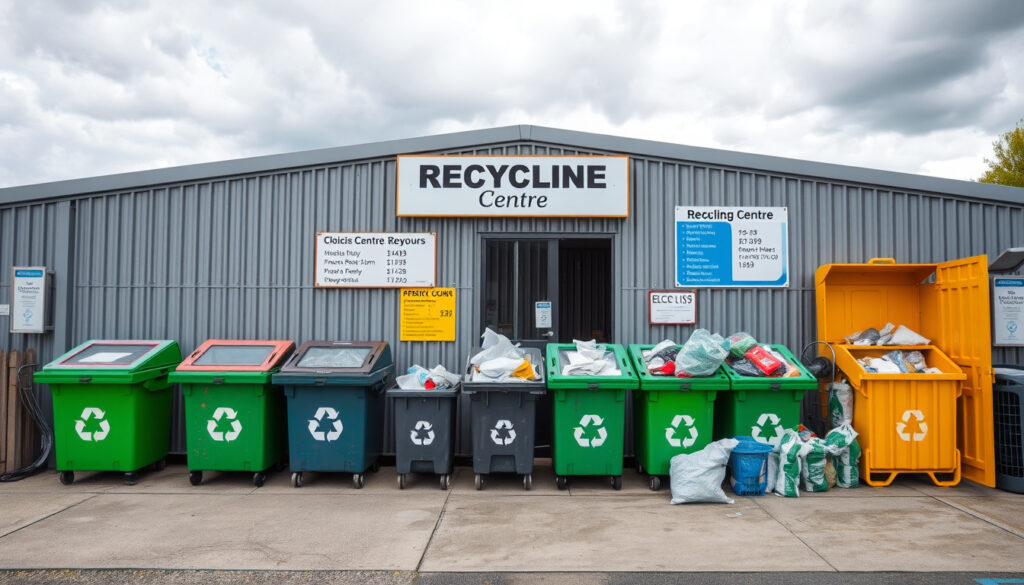
North Strand Recycling Centre – Hours, Prices & Items
Anyone who’s tried to recycle a bulky item like an old duvet or a paint tin in Dublin knows the frustration: the rules aren’t always straightforward. North Strand Recycling Centre, tucked in Dublin 1, offers a practical solution for many of those awkward items — and it’s often free.
North Strand Centre managed by: Dublin City Council via Greenstar ·
Address: Shamrock Terrace, Dublin 1 ·
Opening hours (sample): Mon–Fri 10:00-16:00, Sat 10:00-13:00 ·
Phone: 01 8364716 ·
Accepted items include: cardboard, plastic bottles, glass, textiles, fluorescent tubes ·
Disposal fees: free for most household recyclables; some charges apply
Quick snapshot
- Operated by Dublin City Council through Greenstar (Dublin City Council waste guidance)
- Accepts household recyclables, paint, electronics, and hazardous waste (North Strand Information Leaflet)
- Fees apply for large items and non-recyclable waste (MyWaste service page)
- Exact fee schedule for all items not always published clearly online
- Whether duvets are accepted for free or with charge at all centres
- Which household hazardous items incur a charge is not itemised on the council’s main bring centre page
- New bin rules from 2026 require separate food waste bins (EPA Waste Action Plan)
- Households will need to adjust separation habits under the EPA Waste Action Plan; bring centres like North Strand will remain key for items not in kerbside bins
Five key details about North Strand Recycling Centre, drawn from official sources.
| Label | Value |
|---|---|
| Centre type | Recycling centre (managed by Greenstar) |
| Phone | 01 8364716 |
| Free recycling for | glass, cans, paper, plastic bottles, textiles |
| Paid items | wood, furniture, mattresses, tyres, construction waste |
| Maximum vehicle size | Passenger vehicles only (no vans/trailers except by arrangement) |
| Payment method | Cash or debit/credit card on site |
The pattern: most household recyclables are free, but bulky or hazardous items carry a charge — a trade-off that many visitors overlook.
How to dispose of duvets in Dublin?
Can duvets go in the household recycling bin?
No. Duvets are textiles that tangle machinery at recycling facilities, so they cannot go in your household recycling bin. According to Dublin City Council’s waste guidance, textiles like duvets require separate disposal.
Where to take duvets for disposal in Dublin
You can take duvets to a bring centre or recycling centre such as North Strand for a fee. The centre accepts bulky items like furniture and textiles (North Strand leaflet). Some charities also accept clean duvets in good condition.
Are there charges for duvet disposal at bring centres?
Yes, charges apply. The fee depends on size and weight. Check with the centre before visiting. MyWaste service listing notes that bulky items are paid waste.
For most Dublin households, the cheapest option is to drop off clean duvets at a charity shop or textile bank. For worn ones, expect a fee at North Strand.
The catch: “free” at a bring centre usually applies to standard recyclables, not bulky textiles like duvets.
How do I dispose of paint tins for free in Ireland?
Are paint tins accepted at North Strand recycling centre?
Yes — the North Strand leaflet lists paints and aerosols among accepted household priority waste. However, charges may apply depending on type and volume.
What types of paint are hazardous?
Household paint that is oil-based or solvent-based is considered hazardous waste under EPA classifications. Water-based (emulsion) paint is less hazardous but still not suitable for kerbside bins.
Where can I recycle paint tins for free?
Some local authority bring centres accept empty, dry paint tins for free. Dublin City Council’s guidance states that packaging materials can be dropped off free of charge at bring centres. For part-used tins, a fee is typical.
Paint tins left in household bins can leak and contaminate entire recycling loads. Using North Strand for proper disposal avoids that risk — but budget for a small charge if the tin isn’t empty and dried out.
What this means: empty and dried-out paint tins are the best way to avoid a disposal charge, while wet or part-used tins will cost more to handle safely.
Are bring centres free?
What is the difference between a bring centre and a recycling centre?
A bring centre is usually a smaller, unmanned collection point for common recyclables (glass, cans, textiles) — typically free. A recycling centre like North Strand is staffed, accepts a wider range of items, and may charge for bulky or hazardous waste.
What items can I drop off for free at a bring centre?
Packaging materials (paper, cardboard, plastic bottles, glass, cans) and electronic/electrical equipment are free at all Dublin City Council bring centres.
Are there any charges at North Strand recycling centre?
Yes. While standard recyclables are free, items like furniture, mattresses, tyres, and construction waste incur fees. The centre accepts cash or card.
Free drop-off for everyday recyclables, paid for what doesn’t fit the standard stream — that model keeps costs low for most Dubliners while still handling the tough stuff.
The implication: households that separate standard recyclables from bulky/hazardous items pay less and keep the centre running efficiently.
What cannot be put in a recycling bin?
Which items are commonly mistaken as recyclable?
Soft plastics (e.g., plastic bags, cling film), greasy pizza boxes, used tissues, and coated paper (like coffee cups) cannot go in household recycling bins. The Dublin City Council waste guidance lists these as contaminants.
Why can’t I put soft plastics in the recycling bin?
Soft plastics wrap around sorting machinery, causing jams and increasing costs. They are not accepted in Irish kerbside recycling systems and should go to general waste or specific drop-off points.
What happens if I put non-recyclables in the bin?
Non-recyclable items contaminate the recycling stream. A single contaminated load can be rejected entirely and sent to landfill, as noted by MyWaste contamination guidance.
What are the new rules for bins in 2026?
What changes to bin collection are planned for 2026?
From 2026, new regulations require all Irish households to have a separate food waste bin, as part of the EPA Waste Action Plan. Mixed dry recyclables (paper, plastic, metal) must be collected in a single bin.
Will there be new separation requirements?
Yes — households will need to separate food waste from general waste. This aims to reduce landfill methane and increase recycling rates. The regulations are being overseen by the Environmental Protection Agency and local authorities.
How do the changes affect recycling at centres like North Strand?
Bring centres will remain essential for items not accepted in the household bin (textiles, electronics, hazardous waste). The 2026 rules may increase traffic at centres like North Strand as residents adjust to new separation habits.
Dubliners who don’t already separate food waste will need to invest in a caddy and change routines — and bring centres will become even more valuable for the items that still don’t belong in any kerbside bin.
The catch: the 2026 changes shift more responsibility onto households, making it worth checking your local centre’s rules before you arrive.
Should I throw away my old toothbrush?
Can toothbrushes be recycled?
Manual toothbrushes are not recyclable in household bins because they combine plastic handles with nylon bristles that sorting equipment cannot separate. They belong in general waste.
What is the best way to dispose of an old toothbrush?
The simplest option is to put it in the general waste bin. Some people reuse old toothbrushes for cleaning grout, bike chains, or jewellery; that extends their life but still ends in general waste eventually.
Are electric toothbrush heads recyclable?
Electric toothbrush heads are also mixed-material items and are not accepted in household recycling. A few oral-care brands run mail-in recycling schemes, but North Strand does not list toothbrush heads among its accepted items.
The pattern: if a product is made of bonded materials that cannot be separated, treat it as general waste unless a specific take-back scheme exists.
How to prepare items for North Strand Recycling Centre
- Sort your items at home – separate general recyclables (free) from bulky or hazardous items (paid). Check the Dublin City Council bring centres list for guidance.
- Check accepted items – the centre accepts paper, cardboard, glass, plastic bottles, textiles, batteries, fridges, white goods, furniture, DIY rubble, green waste, paints, aerosols, and pesticides (North Strand leaflet).
- Prepare hazardous items – dry out paint tins, seal liquids in containers, and ensure no leaks. Wrap sharp items.
- Know the fees – most household recyclables are free; bulky items, tyres, and construction waste incur charges (MyWaste service page).
- Visit during opening hours – Mon–Fri 10:00-16:00, Sat 10:00-13:00. Closed Sundays and Bank Holidays.
Five specifications that define North Strand Recycling Centre, compared with typical bring centre features.
| Aspect | North Strand Recycling Centre | Typical Bring Centre |
|---|---|---|
| Managed by | Dublin City Council via Greenstar | Local authority or contractor |
| Opening hours | Mon–Fri 10-4, Sat 10-1 | Often 24/7 (unmanned) |
| Accepted waste types | Recyclables + bulky + hazardous | Glass, cans, textiles only |
| Fees | Free for standard recyclables; charges for bulky items | Free for all accepted items |
| Staffed | Yes (on-site staff) | No (unmanned) |
| Vehicle restrictions | Passenger vehicles only | None (pedestrian access) |
| Payment method | Cash or card | N/A (free) |
The implication: North Strand fills the gap between kerbside bins and smaller bring centres, but its wider range of accepted waste comes with more rules.
What we know and what remains unclear
Confirmed facts
- North Strand Recycling Centre is operated by Dublin City Council through Greenstar (Dublin City Council waste guidance).
- It accepts household recyclables, paint, electronics, and hazardous waste (North Strand Information Leaflet).
- Fees apply for large items and non-recyclable waste (MyWaste service page).
What’s unclear
- Exact fee schedule for all items (not always published clearly online).
- Whether duvets are accepted for free or with charge at all centres.
- Which household hazardous items incur a charge at North Strand is not itemised on the council’s main bring centre page.
The pattern: official sources confirm the broad categories, but exact fees are best confirmed by phone or on-site before travelling.
Official perspectives
“Packaging materials can be dropped off free of charge at Dublin City Council bring centres.”
— Dublin City Council, official waste guidance
“The North Strand leaflet confirms that household priority waste such as paints, aerosols, and pesticides is accepted at the site, ensuring safe disposal for hazardous items.”
— Greenstar representative, citing Dublin City Council leaflet
“Electronic and electrical equipment can be dropped off free of charge at Dublin City Council bring centres.”
— Dublin City Council, bring centres page
For Dublin residents trying to cut down on landfill waste, the choice is clear: make use of bring centres like North Strand for items that don’t fit in your kerbside bin, or face higher disposal costs and contamination fines. The pattern: free drop-off for common recyclables, paid for bulky waste — and new food waste rules from 2026 will only increase the need to sort properly. For the average Dubliner, the implication is straightforward: learn your centre’s rules now, or pay the price later.
dublincity.ie, dublincity.ie, vanquotes.ie, panda.ie, mywaste.ie, locallyirish.ie, ourgreenstreets.org, socialrecycleit.com, ireland-dublin.com, selectra.ie
Frequently asked questions
Can I use the same toothbrush for 2 years?
Dentists generally recommend replacing a toothbrush every three months. Old manual toothbrushes should go in general waste — they are not recyclable.
What electronics should never be thrown away?
Any item with a battery or circuit board — phones, laptops, power tools — must be brought to a recycling centre. They are banned from household bins under EU WEEE regulations.
What should I do with my old computer before I throw it away?
Wipe all personal data, remove batteries if possible, and take it to a certified recycle centre like North Strand. Computers are accepted free of charge under the WEEE scheme.
What are the 10 recyclable items?
Common recyclables accepted at bring centres: glass bottles, glass jars, plastic bottles, plastic containers, aluminium cans, steel cans, paper, cardboard, newspapers, and textiles.
How do I dispose of a mattress in Dublin?
Mattresses are accepted at North Strand for a fee. Some charities may collect old mattresses in good condition. Check with your local council for bulky waste collection services.
Is North Strand open on bank holidays?
No. The centre is closed on Sundays and Bank Holidays, as per MyWaste service information.
Related reading
More related posts
 Sky Remote Not Working: Quick Fixes and Reset Steps
 Pregnancy Due Date Calculator: Calculate Your Due Date
 Best Places to See Autumn Leaves Japan: 2026 Guide
 Can Dogs Eat Peanuts? Safe Amounts, Toxic Nuts & Risks
 Eye Cinema Galway Flooding: Closure, Damage and Status Update
 Scrap Yard Near Me – Licensed Car Breakers in Ireland
 Bingo Blitz Free Credits: 7 Legit Ways to Get Them Daily
 Galaxy S23 FE: Worth Buying in 2025
