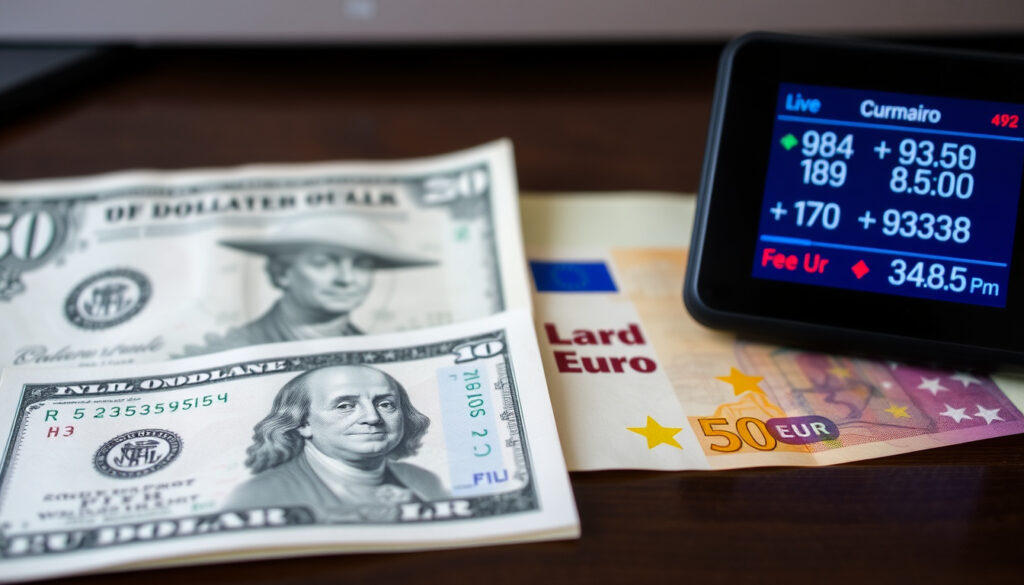
150 Dollars to Euro: Live Rate and Fee Comparison
You’ve got $150 and want to know how many euros that lands you—the answer changes by the minute, and the actual cost varies by where you exchange. This guide breaks down the live rate, compares real costs across services, and helps you pick the smartest way to convert.
Current exchange rate: 1 USD = 0.877 EUR (mid-market) ·
150 USD in EUR: 131.55 EUR ·
Top converter used: Revolut (75+ million users)
Quick snapshot
- 150 USD = approximately 131.55 EUR at mid-market rate (IBAN (currency data provider))
- Exact fees and final rate at the moment you convert depend on provider and time (Revolut (regulated financial service))
- Exchange rates update every few seconds; always check before converting (Xe (real-time currency converter))
- Use Wise or Revolut to lock mid-market rates and avoid bank markups (Wise (transparent fee service))
For a simple $150 conversion, the difference between using a bank and a digital service can cost you up to $15 in hidden fees. The trade-off is clear: choose a provider that shows you the mid-market rate up front.
How much is $150 US in euros?
Current USD to EUR exchange rate for 150 dollars
At the mid-market rate, 1 US dollar buys approximately 0.877 euros. Multiply that by 150, and you get 131.55 EUR. But that’s the raw wholesale number, not necessarily what lands in your pocket. The rate you actually receive depends on the service you use — and the gap between “live” and “you get” is where fees hide.
- IBAN reports a live rate of 0.8771 EUR per USD (IBAN (currency data provider)).
- Xe shows about 0.8769 EUR per USD (Xe (real-time converter)).
- Wise displays a mid-market rate of roughly 0.8516 EUR per USD for 150 USD (Wise (transparent fee service)).
Using electronic money transfer services vs. bank rates
Four providers, one amount, different outcomes. Here’s how they stack up for a 150-dollar conversion.
Revolut Standard users who convert outside market hours (weekend evenings) pay an extra 1% — that’s $1.50 on $150, invisible until you check the settled amount.
A quick look at the numbers reveals a pattern: digital services tend to offer rates close to mid-market, while banks and traditional exchangers embed wider margins.
| Provider | Exchange rate (USD to EUR) | Fees for $150 |
|---|---|---|
| Revolut (Standard, market hours) | ~0.877 | 0% (fair use limit $1,000/month; after that 0.5%) |
| Wise | ~0.8516 | Transparent fee ~0.41% (≈$0.62 on $150) |
| Xe | ~0.8769 | No explicit fee, rate includes spread |
| Western Union | ~0.8589 | Varies by payment method; shown as estimate |
| U.S. Bank (foreign currency order) | Unknown bank rate | $10 flat fee for orders ≤$300 |
Sources: Revolut (regulated financial service), Wise (transparent fee service), Xe (real-time converter), Western Union (global money transfer), U.S. Bank (retail banking).
How much is $1 to €1?
Base exchange rate explanation
The pair USD/EUR is one of the most traded currency pairs globally. At time of writing, one US dollar buys about 0.877 euros. The inverse rate — how many dollars you get for one euro — is roughly 1.14 USD per 1 EUR (IBAN (currency data provider)). These mid-market rates are wholesale prices set by the interbank market, not the rate you’ll see at a retail counter.
- 1 USD = 0.877 EUR (mid-market).
- 1 EUR = 1.14 USD (inverse).
How to calculate any amount from dollars to euros
The formula is straightforward: amount in USD × current exchange rate (USD to EUR) = amount in EUR. For $150, that’s 150 × 0.877 = 131.55 EUR. For $200, 200 × 0.877 = 175.40 EUR. The trick is getting the real rate — not the advertised one — after fees are applied. Always multiply by the rate the provider actually offers, which may be 0.5% to 3% lower than the mid-market rate (Georgia’s Own Credit Union (financial education)).
The catch: The “live rate” you see on Google or a converter site is rarely what you get at checkout. The difference is the spread, and providers make money off it.
What is the weakest currency in the world?
List of weakest currencies by value
When measured against the US dollar, the weakest currencies are those that require enormous numbers of units to buy one dollar. According to various financial rankings, the Iranian rial, Vietnamese dong, and Lebanese pound consistently appear at the bottom. For example, 1 USD equals roughly 42,000 Iranian rials, 25,000 Vietnamese dong, and 15,000 Lebanese pounds. These extreme ratios reflect inflation, sanctions, or economic instability rather than low purchasing power in local markets.
- Iranian rial (IRR): ~42,000 IRR per 1 USD.
- Vietnamese dong (VND): ~25,000 VND per 1 USD.
- Lebanese pound (LBP): ~15,000 LBP per 1 USD.
Source: Xe (real-time currency converter) (Xe also tracks major currency pairs; weakest currency data based on publicly available exchange rates).
Why some currencies have low value against the dollar
A currency’s exchange rate reflects the market’s view of that country’s economic health. High inflation, political instability, large debt, or lack of foreign reserves can drive the value down. For example, the Iranian rial has been weakened by international sanctions and inflation. The Vietnamese dong is kept low by the government to support export competitiveness. Importantly, a “weak” currency doesn’t mean the country’s people are poor — it means one dollar buys a lot of local units, which can make exports competitive.
Why this matters: If you’re converting 150 dollars to a weak currency, you’ll get millions of units. But for euro conversion, small percentage differences matter more because the EUR is strong against the USD.
Is it safe to exchange money on Revolut?
Security measures and regulation of Revolut
Revolut is a financial technology company regulated in multiple jurisdictions: the UK’s Financial Conduct Authority, the US state of New York (BitLicense), and the European Central Bank via its Lithuanian banking license. It offers fraud monitoring, two-factor authentication, and €100,000 deposit protection for EU customers under the Deposit Guarantee Scheme (Revolut (regulated financial service)). For US customers, funds up to $250,000 are covered by FDIC insurance through partner banks.
- Regulated in UK (FCA), US (NY BitLicense), EU (Lithuanian license).
- Deposit protection up to €100,000 (EU) / $250,000 (US).
- Standard users: 1% fee for weekend conversions outside market hours (Revolut (regulated financial service)).
Alternatives like Wise and Xe for currency exchange
If Revolut doesn’t suit you, two well-regarded alternatives are Wise and Xe. Wise uses the mid-market rate and shows fees transparently before you confirm (Wise (transparent fee service)). Xe offers live charts, rate alerts, and a simple interface with no hidden subscription fees (Xe (real-time converter)). Both are licensed and have been operating for over a decade.
The trade-off: Revolut is great if you already use it as a banking app, but its fee structure is complex. Wise is simpler for one-off conversions. Xe is best for tracking rates over time.
“Join 75+ million global customers who trust Revolut for currency exchange.”
— Revolut website
“Our interactive USD to EUR chart uses real-time mid-market exchange rates.”
— Wise website
How much is 150 dollars to pounds?
Current GBP rate for 150 USD
The USD to GBP rate typically hovers around 0.79 GBP per 1 USD. At that rate, 150 dollars would convert to approximately 118.50 GBP at the mid-market level (IBAN (currency data provider) cross-rate available). As with euros, the actual rate you get depends on the provider. The fees and spread for GBP tend to be similar to EUR conversions, though the GBP/USD pair is slightly less volatile than EUR/USD.
Comparison with euro conversion for the same amount
Both conversions involve similar fee structures: banks charge $10 flat or 1–3% fee, digital services charge 0.4–1%. Because the euro trades closer to parity than the pound, 150 USD yields roughly 13 more euros than pounds. But the total cost in fees is comparable — expect $2–$5 in fees from a digital provider, or $10–$15 from a traditional bank for either currency.
| Amount | To EUR (mid-market) | To GBP (mid-market) |
|---|---|---|
| $150 | 131.55 EUR | 118.50 GBP |
| $100 | 87.70 EUR | 79.00 GBP |
| $200 | 175.40 EUR | 158.00 GBP |
The pattern: Whether you’re converting to euros or pounds, the key variable is the same: use a service that shows you the mid-market rate and charges a transparent fee. The dollar difference between the best and worst option for $150 is about $8–$12 for either currency.
Confirmed facts
- 150 USD equals approximately 131.55 EUR at current mid-market rate (IBAN (currency data provider); Xe (real-time converter)).
- Revolut is a regulated financial service with deposit protection (Revolut (regulated financial service)).
- Wise offers mid-market rates with transparent, low fees (Wise (transparent fee service)).
- U.S. Bank charges a $10 flat fee for foreign currency orders up to $300 (U.S. Bank (retail banking)).
- Foreign transaction fees on credit cards range from 1% to 3% (GSA SmartPay; Georgia’s Own Credit Union (financial education)).
What’s unclear
- The exact rate and fee amount at the moment you convert — these change constantly.
- Future movement of USD/EUR exchange rates.
- Whether your bank will use its own rate or the Visa/Mastercard rate for card transactions.
For the reader converting $150 today, the smart move is to avoid banks and traditional counters. Use Wise or Revolut during market hours, and you’ll keep most of the mid-market value. For the euro-bound traveler or freelancer, the difference between 131.55 EUR and 129.20 EUR might not break the bank — but over repeated conversions, that 2% gap adds up.
Related reading: Euro Rate Today INR
For a similar breakdown on converting $250, see our guide comparing Wise and Revolut rates for a detailed fee comparison.
Frequently asked questions
Does the exchange rate change often?
Yes, currency exchange rates fluctuate by the second based on global trading. For USD/EUR, major shifts happen daily, but intraday movements are usually a few hundredths of a cent. Always check the rate right before you commit to a conversion.
How can I get the best rate for 150 dollars to euros?
Use a digital service that shows the mid-market rate and adds a low transparent fee — Wise and Revolut (during market hours) are top choices. Avoid airport kiosks, hotel counters, and banks that charge flat fees or use unfavorable rates.
Are there hidden fees when converting USD to EUR?
Yes. Many providers embed the fee in the exchange rate by using a spread (offering a rate worse than mid-market). Others charge a separate fee listed as “exchange fee,” “service fee,” or “foreign transaction fee.” Always look at the total amount you receive, not just the rate.
Should I use a bank or an online converter for small amounts?
For small amounts like $150, online converters like Wise, Revolut, or Xe are almost always cheaper than banks. Banks often charge a flat fee ($10 or more) or a percentage fee that eats a significant part of a small conversion.
What is the weakest currency compared to the US dollar?
The Iranian rial is widely considered the weakest, with 1 USD equal to roughly 42,000 IRR. The Vietnamese dong and Lebanese pound are also among the weakest major currencies.
Can I trust online currency converters like Revolut or Wise?
Yes. Both are regulated in major markets (UK, US, EU) and have been operating for years. They use security measures like 2FA, encryption, and deposit protection. Check their terms for any limits or weekend fees before converting.
More related posts
 Pregnancy Due Date Calculator: Calculate Your Due Date
 Property For Sale Clare – 2025 Prices and Market Trends
 Love Holidays Discount Code: How to Save with Verified Deals
 Good Morning in French: Bonjour, Bonsoir & Greetings
 Single Room to Rent in Dublin: Average Costs & Tips for 2025
 Kids Table and Chairs: Size Guide & Age Recommendations
 Best Movies on Streaming: Top Picks by Ratings & Free Options
 Meaghers Pharmacy Baggot Street: Hours, Phone, Services & More
