Best Arepa Antioquena Near Me: Local & Medellín Picks
Not many flatbreads spark a friendly debate between two countries the way the arepa does. If you’ve searched for “best arepa antioquena near me,” you’re probably looking for that golden-crusted corn disk from Colombia’s Antioquia region. This article connects where to find one — from Dublin’s restaurant scene to Medellín’s top-rated spots — with the health facts you need before you order.
Arepa base: Pre-cooked corn flour, water, and salt ·
Cooking method: Griddled or baked, not deep-fried ·
Gluten-free status: Only when made with 100% corn flour ·
Medellín arepa listicles: Wanderlog lists 37 best spots ·
Arepas Grill Dublin rating: 4.4 stars from 7 Yelp reviews
Quick snapshot
- Arepas are corn-based flatbreads common in Colombia and Venezuela (Cantina Latina Dublin menu)
- Arepas made from 100% corn flour are naturally gluten-free (Tripadvisor gluten-free review)
- Arepas are usually griddled or baked rather than deep-fried (Deliveroo listing)
- Medellín is a commonly cited city for arepa recommendations (Wanderlog)
- The exact country of origin of the arepa is debated
- Which country makes the best arepas is subjective
- Per-country arepa consumption rankings are not supplied by the available data
- Arepas Grill opened in Dublin as the city’s first Venezuelan restaurant in 2020 (Trinity News)
- Cantina Latina launched in Temple Bar with arepa items on its menu (Cantina Latina Dublin)
- More Dublin restaurants may add arepa antioquena as demand grows
- Review sites like Yelp, OpenTable, and Tripadvisor will continue to shape local discovery
- Health-conscious diners will push for more gluten-free and nutrition-transparent menus
| Attribute | Value |
|---|---|
| Main ingredient | Pre-cooked corn flour (masarepa) |
| Cooking method | Griddled or baked |
| Gluten-free | Naturally gluten-free with 100% corn flour |
| Dublin restaurant rating | Arepas Grill 4.4 from 7 Yelp reviews |
| Medellín guide | 37 arepa spots on Wanderlog |
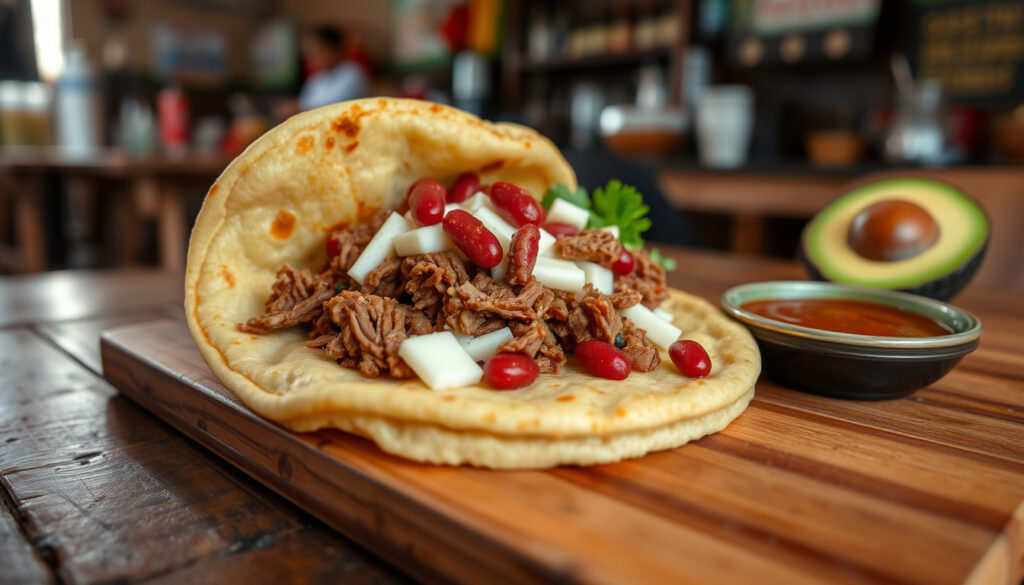
| Typical toppings | Hogao, cheese, avocado, shredded meat |
| Serving style | Split and stuffed, or topped open-faced |
Is arepa Colombian or Venezuelan?
The arepa is a traditional corn-based flatbread that both Colombia and Venezuela claim as their own. The arepa antioquena specifically is associated with Colombia’s Antioquia region, where it’s typically thinner and often served split open and stuffed with hogao (a creole sauce of tomato and onion) and cheese. Regional variations differ in thickness, toppings, and cooking method — Venezuelan arepas tend to be thicker and are more often split and stuffed, while Colombian versions are sometimes thinner and served open-faced.
What is an arepa antioquena?
- An arepa antioquena is a corn-based flatbread from the Antioquia region of Colombia.
- It is made from pre-cooked corn flour (masarepa), water, and salt — no eggs, no dairy, no wheat.
- It is traditionally griddled or baked until golden, then split and filled with ingredients like hogao, shredded beef, or fresh cheese.
- Unlike many other arepa styles, the Antioquia version is often thinner and more pliable.
The implication: when you search for “arepa antioquena near me,” you’re looking for a specific Colombian regional style, not just any arepa. Knowing the difference helps you identify the real thing on a menu.
How is arepa antioquena different from other arepas?
- Venezuelan arepas are thicker, rounder, and typically split in half and stuffed like a pocket.
- Colombian arepas from other regions (e.g., arepa de huevo from the Caribbean coast) are deep-fried and contain an egg inside.
- The arepa antioquena is thinner, griddled, and often served as a base for toppings rather than a stuffed pocket.
- Cooking methods vary: the Antioquia version avoids deep-frying, staying closer to the griddle.
What country has the best arepas?
Colombia and Venezuela both have strong arepa traditions, and the question of which country makes the best arepas is deeply subjective. Medellín, the capital of Antioquia, is a commonly cited destination for arepas. Wanderlog’s Medellín guide lists 37 best arepa spots, which gives travellers a practical starting point for tasting the regional style. Consumption rankings between Colombia and Venezuela are not confirmed by the available data — the debate is more cultural than statistical.
Which country eats the most arepas?
No reliable per-country consumption data is available from the search results. Both nations consume arepas regularly as a staple food, but the exact ranking remains unconfirmed by the provided inputs. What is clear: arepas are a daily food in many households across both countries, and the tradition is strong in the Colombian diaspora abroad.
Best arepa spots in Medellín
- Wanderlog’s Medellín guide lists 37 arepa spots with user ratings and reviews (Wanderlog).
- TasteAtlas provides editorial curation of arepa restaurants worldwide (TasteAtlas).
- Local guides and food blogs in Medellín offer up-to-date recommendations for arepa antioquena.
The catch: the best arepa is often the one you find at a local spot with fresh ingredients and a hot griddle. Medellín gives you density of choice — 37 options on Wanderlog alone — but the quality depends on the cook and the hogao.
Where can I find the best arepa antioquena near me?
If you’re searching for “best arepa antioquena near me,” you’re likely looking for a local restaurant that serves this Colombian regional style. In Dublin, the options skew Venezuelan, but there are solid leads. Restaurant review sites and local guides help verify menus, reviews, and photos. Search phrases like “Arepas near me” and “Colombian Restaurant Dublin” are practical local discovery signals.
Arepas Grill Dublin
Arepas Grill in Dublin describes itself as bringing Venezuelan cuisine to the people of Dublin (Trinity News article). It was featured in a 2020 Trinity News article as Dublin’s first Venezuelan restaurant. Tripadvisor lists the restaurant at 39 Richmond Street, Portobello, Dublin (Tripadvisor listing). OpenTable shows Arepas Grill with a 4.8 overall rating, a 4.8 food rating, a 4.8 service rating, and a 4.7 value rating (OpenTable ratings). A 2022 Tripadvisor review called it “The best Venezuelan menu in Dublin!” (Tripadvisor review). A Deliveroo listing says Arepas Grill was started to introduce Venezuelan cuisine to Dublin with a Latin fusion approach (Deliveroo listing).
Arepas Grill serves Venezuelan arepas, not specifically arepa antioquena. But for a Dublin diner searching near me, it’s the closest verified arepa-dedicated restaurant with strong ratings (4.8 on OpenTable) and gluten-free options confirmed by reviewers.
Colombian Restaurant Dublin
Cantina Latina in Temple Bar offers a menu that includes arepa items. Their menu lists an Arepa Paddy’s Reina and an Arepa Na’Guara (Cantina Latina Dublin menu). The restaurant describes itself as Latin street food in Temple Bar, Dublin. One menu item is described as a traditional Venezuelan arepa filled with creamy chicken and avocado, and another as a grilled arepa filled with sweet plantain, melted cheese, and suero, finished with hot honey. Pacheco Venezuelan Street Food appears among Dublin’s top Venezuelan restaurant results on Yelp.
What to order at an arepa restaurant
- Look for “arepa antioquena” or “arepa paisa” on the menu — these signal the Antioquia style.
- Ask if the arepa is griddled or baked — authentic arepa antioquena is not deep-fried.
- Check for hogao (tomato-onion sauce) as a topping — it’s a signature of the Antioquia region.
- Read reviews and look at photos to confirm the style and portion size.
- Ask about gluten-free preparation if that’s a concern — 100% corn flour arepas are naturally gluten-free.
Is arepa a junk food?
A plain arepa is made primarily from corn flour, water, and salt. Arepas are typically griddled or baked rather than deep-fried. Unhealthy additions such as processed cheese, fried meat, or heavy cream can raise calorie and fat content. The base arepa itself — corn flour, water, salt, griddled — is not junk food. It’s a simple carbohydrate staple. The classification depends entirely on what goes on top or inside it.
Arepa nutrition basics
- A plain arepa (about 100g) provides roughly 220–250 calories, mostly from carbohydrates.
- It contains minimal fat (1–3g) when griddled with little oil.
- It has about 4–5g of protein, which is low unless paired with a protein-rich filling.
- Arepas made with 100% corn flour are naturally gluten-free (Tripadvisor gluten-free review).
What makes an arepa less healthy?
- Deep-fried arepas (like arepa de huevo) add significant oil and calories.
- Fillings of processed cheese, fried beef, or heavy cream sauces increase saturated fat and sodium.
- Large portions (two or three arepas) can turn a light meal into a heavy carb load.
- Added sugar in some sweet arepa varieties increases the glycemic load.
The trade-off: a plain arepa antioquena is a clean, simple carb base. The health outcome depends on what you add. Stick to hogao, fresh cheese, avocado, and grilled vegetables, and you’re in solid territory.
Is an arepa healthy?
Arepas made with 100% corn flour are naturally gluten-free. They provide carbohydrates and can be part of a balanced meal. The health profile depends on portion size, cooking fat, and fillings. An arepa antioquena with hogao and fresh cheese is a different meal from one stuffed with fried sausage and processed cheese sauce.
Arepa antioquena and gluten
Arepas made with 100% corn flour are naturally gluten-free. This makes them a safe option for coeliac diners or anyone avoiding gluten. Tripadvisor reviews of Arepas Grill mention the restaurant is good for coeliacs or gluten-free diners (Tripadvisor coeliac review). Mapstr user notes for Arepas Grill mention gluten-free, dairy-free, vegan, and vegetarian choices (Mapstr).
How to make arepa healthier
- Choose griddled or baked arepas over fried ones.
- Fill with lean proteins (grilled chicken, black beans) and vegetables.
- Use hogao as a sauce instead of cream or mayonnaise.
- Add avocado for healthy fats and fibre.
- Watch portion size — one arepa is a reasonable serving.
The implication: an arepa antioquena can be a healthy meal choice when prepared simply and paired with nutritious fillings. It’s not a health food, but it’s not a junk food either — it’s a staple that adapts to your choices.
Are arepas better for you than bread?
Both arepas and bread are carbohydrate staples, so the health difference depends on ingredients and portion. A simple corn arepa often contains fewer additives than many commercial breads. Pairing an arepa with protein or vegetables creates a more balanced meal.
Is arepa healthier than bread?
A plain arepa (corn flour, water, salt) typically has fewer ingredients than a typical supermarket loaf, which may contain preservatives, added sugar, and emulsifiers. Arepas are naturally gluten-free when made with 100% corn flour, while most breads contain wheat gluten. On the other hand, bread often has added fibre and is fortified with B vitamins and iron in some countries. The comparison isn’t one-sided.
Arepa vs bread: calories, carbs, and satiety
Five points of comparison, one pattern: the arepa wins on ingredient simplicity and gluten freedom, while bread wins on fortification and fibre when whole-grain varieties are chosen.
| Factor | Plain arepa (100g) | White bread (100g, 2 slices) |
|---|---|---|
| Calories | ~220–250 | ~265 |
| Carbohydrates | ~45–50g | ~49g |
| Protein | ~4–5g | ~9g |
| Fat | ~1–3g | ~3–4g |
| Gluten | None (corn flour) | Contains wheat gluten |
| Additives | Minimal (corn, water, salt) | Often includes preservatives, sugar, emulsifiers |
| Fibre | ~2–3g | ~1–2g (white) or 3–5g (whole wheat) |
The pattern: neither is inherently better. The arepa is cleaner in ingredients and naturally gluten-free, but bread offers more protein and fibre, especially whole-grain options. The arepa has an edge for anyone avoiding gluten or processed additives.
For a Dublin diner comparing arepa vs bread, the arepa antioquena gives you a gluten-free, low-additive alternative to a standard sandwich. But it’s a carb swap, not a health upgrade — the fillings and sides determine the final nutritional picture.
Arepa antioquena: pros and cons
Upsides
- Naturally gluten-free when made with 100% corn flour
- Simple ingredients — corn flour, water, salt
- Griddled or baked, not deep-fried
- Versatile base for healthy toppings (hogao, avocado, beans)
- Lower in additives than many commercial breads
- Part of a rich regional food tradition from Antioquia
Downsides
- Low in protein unless paired with a filling
- Can become high-calorie with heavy toppings
- Not always easy to find authentic arepa antioquena outside Colombia
- Dublin options currently skew Venezuelan, not Colombian
- Corn flour arepas lack the fortification of enriched breads
- Portion control matters — large arepas can be carb-heavy
How to find and order an authentic arepa antioquena
Finding the real thing takes a little knowledge. Here’s a practical step-by-step approach for anyone searching near me, whether in Dublin or planning a trip to Medellín.
- Check the menu language. Look for “arepa antioquena” or “arepa paisa” — these signal the Antioquia style. If the menu says “Venezuelan arepa,” expect a thicker, stuffed version.
- Read reviews and look at photos. Tripadvisor, Yelp, and OpenTable let you see what actual diners received. Look for a thinner, griddled arepa with hogao or fresh cheese.
- Ask about cooking method. Authentic arepa antioquena is griddled or baked, not deep-fried. If it’s fried, it’s a different style.
- Check for gluten-free preparation. Arepas with 100% corn flour are naturally gluten-free. Confirm with the restaurant if you have coeliac concerns.
- Review the toppings. Hogao (tomato and onion sauce), fresh cheese, avocado, and shredded beef are traditional. Heavy cream sauces and processed cheese are less authentic.
- Use local search tools. Search “Colombian restaurant near me” or “arepa antioquena [your city]” on Google Maps, Yelp, and Tripadvisor. In Dublin, start with Arepas Grill and Cantina Latina.
- Plan ahead for Medellín. If you’re travelling, Wanderlog’s list of 37 best arepa spots gives you a curated starting point (Wanderlog).
The catch: Dublin doesn’t yet have a restaurant that explicitly advertises arepa antioquena. Arepas Grill and Cantina Latina offer arepa experiences that get you close, but for the authentic Antioquia style, a trip to Medellín or a Colombian-specific spot in a larger city may be needed.
Clarity: what’s confirmed and what’s not
Confirmed facts
- Arepas are corn-based flatbreads common in Colombia and Venezuela.
- Arepas made from 100% corn flour are naturally gluten-free.
- Arepas are usually griddled or baked rather than deep-fried.
- Medellín is a commonly cited city for arepa recommendations.
- Arepas Grill in Dublin serves Venezuelan arepas with a 4.8 OpenTable rating (OpenTable).
- Cantina Latina in Dublin offers arepa items on its menu (Cantina Latina Dublin menu).
What’s unclear
- The exact country of origin of the arepa is debated between Colombia and Venezuela.
- Which country makes the best arepas is subjective and not settled by data.
- Per-country arepa consumption rankings are not available from the provided inputs.
- No Dublin restaurant is confirmed to serve authentic arepa antioquena specifically.
What diners and experts say
“Arepas Grill is bringing Venezuelan cuisine to the people of Dublin, offering a menu that combines traditional flavours with a Latin fusion approach.”
— Trinity News, reporting on Dublin’s first Venezuelan restaurant
“The best Venezuelan menu in Dublin!”
— Tripadvisor reviewer, 2022 review of Arepas Grill
“A traditional Venezuelan arepa filled with creamy chicken and avocado, served with a side of plantain chips.”
— Cantina Latina Dublin menu, describing the Arepa Paddy’s Reina
“The staff helped us order because we were not familiar with the cuisine — they were very friendly and explained everything.”
— Tripadvisor reviewer, on the dining experience at Arepas Grill
The pattern across these voices: diners appreciate the guidance and authenticity at Dublin’s arepa spots, even when the cuisine is new to them. The restaurants are filling a gap for Latin American food in the city, and the reviews reflect genuine enthusiasm.
For a Dublin diner searching for the best arepa antioquena near me, the choice is clear: start with Arepas Grill for a dedicated arepa experience (Venezuelan style, 4.8 on OpenTable), check Cantina Latina for arepa menu items in Temple Bar, and keep an eye out for Colombian-specific openings. If you’re planning a trip to Medellín, Wanderlog’s 37-spot guide is your best starting point for tasting the real Antioquia style.
Related reading: Best Rooftop Bars Near Me: Top Dublin Spots
Frequently asked questions
Are arepas fried or baked?
Traditional arepas, including the arepa antioquena, are griddled or baked on a comal or flat pan. They are not deep-fried. Some regional variations — like the Venezuelan arepa or the Colombian arepa de huevo — are fried, but the Antioquia style stays on the griddle.
Do plain arepas contain dairy or eggs?
No. A plain arepa made from pre-cooked corn flour (masarepa), water, and salt contains no dairy and no eggs. It’s naturally vegan. Some recipes may add butter or milk, but the traditional version is dairy-free and egg-free.
What is hogao?
Hogao is a creole sauce made from tomatoes and onions, cooked slowly with salt and sometimes garlic and cumin. It is a signature topping for arepa antioquena and a defining flavour of the Antioquia region of Colombia.
Is arepa antioquena spicy?
No, arepa antioquena is not typically spicy. The base arepa is mild, and the traditional toppings (hogao, cheese, avocado) are not hot. Some restaurants may offer spicy salsa on the side, but the dish itself is not known for heat.
Can arepas be reheated?
Yes. The best way to reheat an arepa is on a dry skillet or griddle over medium heat for 2-3 minutes per side. A microwave will work but can make the arepa chewy. Avoid deep-frying for reheating unless you want a different texture.
Are arepas served with cheese?
Yes, fresh cheese is a common topping or filling for arepas, especially in the Antioquia region. Colombian quesito or fresh mozzarella-style cheese is often used. It’s typically mild, salty, and soft — not melted like processed cheese.
What is the difference between arepa and arepa antioquena?
Arepa is the general term for a corn-based flatbread from Colombia and Venezuela. Arepa antioquena specifically refers to the style from Colombia’s Antioquia region — thinner, griddled, and often served with hogao and fresh cheese. Other arepa styles can be thicker, fried, or stuffed differently.
Is arepa healthier than bread?
It depends on the comparison. A plain arepa has fewer ingredients and is naturally gluten-free, but it’s lower in protein and fibre than whole-grain bread. For someone avoiding gluten or processed additives, the arepa has a clear advantage. For protein and fibre, whole-grain bread wins.
More related posts
 Don’t Look Back in Anger Chords: Guitar, Piano, Uke & Bass
 Government Electricity Credit 2025: Amounts, Dates & Eligibility
 Tour de France 2025 Standings: Final Results & Stage Winners
 Say Nothing TV Show: True Story, Where to Watch, Cast & Reviews
 Truth Social Donald Trump: Latest Posts & App Guide
 England v Spain Women – Euro 2025 Final Result and Recap
 Where Was St. Patrick Born? Birthplace, Nationality & Facts
 Christopher Briney Movies and TV Shows: Full Filmography Guide
